

The tongue drum, also known as the steel tongue drum, is a fascinating instrument that is attracting more and more players. If you are a beginner, do not worry! You can learn to read sheet music for this instrument using simple notation systems.
There are two main methods: numbered notation and letter notation. In the first, each note is represented by a number. For example, do is 1, re is 2, and so on. The second uses letters, from C to B. These systems make learning much more intuitive.
When reading sheet music, follow the usual direction: from left to right and top to bottom. Each number or letter indicates a note to play by striking the corresponding tongue on your instrument. This makes practice much simpler and lets you play your favorite melodies with confidence.
Why learn to read tongue drum sheet music?
Learning to read music for the tongue drum opens up a rich musical world. It lets you play your favorite melodies with ease. Once you master this skill, you can play any song, even one you have never heard before.
Play your favorite melodies with ease
Reading sheet music is essential for playing a variety of melodies. It gives you access to a vast repertoire. With sheet music to guide you, you can avoid awkward moments when performing in public. You no longer have to rely entirely on memory to recall the notes.
Avoid mistakes and improve your visual memory
Sheet music acts as a safety net. It helps you avoid losing your place and playing wrong notes. According to Emmanuel Bigand, a laboratory director at the French National Centre for Scientific Research (CNRS), learning music strengthens visual memory. It also improves intellectual performance.
Develop your technical command of the instrument
With experience, you will be able to read sheet music without looking at your instrument. You can then play more smoothly and accurately. As you learn to read the notes, you will become familiar with the position of every tongue on your steel tongue drum.
- Mastering sheet music gives you the freedom to play all your favorite songs.
- Using sheet music as a safety net reduces the risk of mistakes during performances.
- Regular reading stimulates your visual memory and helps you recognize note sequences.
- Learning to play without looking at the instrument builds confidence and improves your playing.
- Explore a vast repertoire of melodies, from simple tunes to advanced pieces.
Understanding tongue drum notation systems
Understanding notation systems is essential for progressing with your tongue drum. There are two main types of sheet music: simple arrangements for beginners and more advanced arrangements that draw on music theory. These systems provide a structured, accessible way to approach music.
Simplified numbered notation (do = 1, re = 2, …)
Simplified numbered notation, also known as abbreviated Arabic numeral musical notation, creates an intuitive link between numbers and notes. For example, do is 1, re is 2, and so on up to ti, which is 7. This system shortens the time between reading a note and playing it, making it much easier to read the music smoothly.
Letter notation (C, D, E, …)
Letter notation uses letters to represent notes: C for do, D for re, E for mi, and so on. It is particularly useful if you already have experience with instruments such as piano or guitar. It also makes it easier to find pieces in the vast musical repertoire.
Matching solfège syllables, numbers and letters
The rules that apply to numbers also apply to letters. Sometimes a number follows a letter to indicate the octave, as in D4, which is one octave below D5. To switch easily between systems, consult a note conversion chart. It will help you identify notes regardless of the notation used.
Choosing one notation system at first will help you avoid confusion. Over time, you can learn to match numbers with letters. You will then be able to read any sheet music you encounter as you learn.
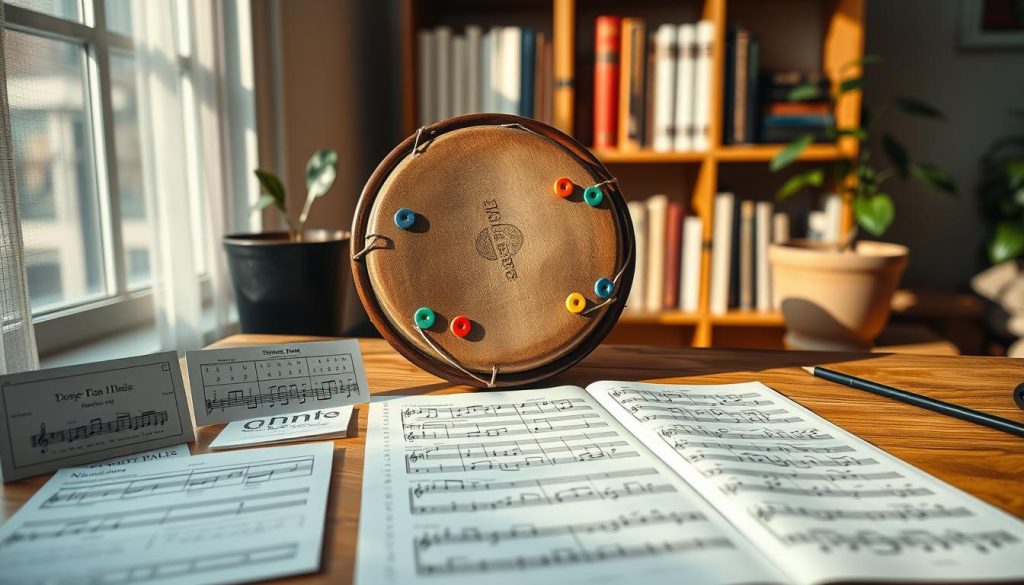
How to read tongue drum sheet music easily: Step by step
Reading music for your instrument may seem complicated, but a clear method makes it simple. A structured approach is essential for beginners. It helps you progress quickly and play your favorite melodies accurately.
Read in the usual direction: left to right and top to bottom
Use the simplest, most natural reading method for your instrument: always read your sheet music from left to right and top to bottom, as you would read a book. Play each note in the order it appears to reproduce the melody faithfully.
Identify the notes to play from the numbers or letters
Use the numbers or letters on the sheet music to identify the notes you need to play. Each symbol corresponds to a particular tongue on your instrument. Strike it with a mallet or finger to produce the intended sound.
Recognize chords and simultaneous notes (parentheses and hyphens)
Learn to recognize chords and notes played together by their symbols. For example, parentheses, as in (16), mean you should play do and la at the same time. Hyphens, as in 1-6, indicate that you should strike several tongues simultaneously to create a rich harmony.
Follow this tried and tested method step by step:
- First, find the time signature and beat on your sheet music.
- Set a metronome to a slow tempo and count the beats aloud.
- Read one note at a time, keeping strictly to the tempo until you can play it three times without a mistake.
Use visual tablature with circular diagrams and color coding. These diagrams show exactly where the tongues you need to strike are located and greatly reduce errors in finding them.
Progress at your own pace by starting with simple beginner pieces. You can place note stickers on your instrument’s tongues to make it easier to connect what you read with what you play.
Practice reading a complete line of music without stopping, even if you make a mistake. This will improve your reading fluency and your ability to anticipate the next notes while keeping a steady tempo.
As you read the music, listen closely to the sound produced by each tongue. This builds a connection between your eyes, hands and ears, greatly speeding up your learning and improving your accuracy.
Essential symbols for interpreting rhythm and timing
Certain symbols play a crucial role when you read sheet music. They tell you about the rhythm and duration of notes. Become familiar with them to enrich your playing.
Hyphens and lines: lengthening and shortening notes
Hyphens indicate that a note is prolonged. A hyphen placed before a number means the note should last twice as long. Conversely, a line beneath a number indicates a shorter duration. For example, two lines mean the note lasts one quarter as long. These symbols help you play faster passages accurately on your tongue drum.
Dots above and below: reading octaves
Dots add another detail to the notation. A dot above a number means the note should be played one octave higher. A dot below means it should be played one octave lower. Sometimes symbols such as “°” or “*” are used instead. For example, 1° or 1* represents do in the higher octave. Learn these variations so you can read different arrangements easily.
The number 0 and rests in sheet music
The number 0 has a special meaning. It represents a rest, a moment when you should not strike any tongue. A rest is just as important as a note: it shapes the rhythm and gives the melody room to breathe. You can treat 0 as a chance to add texture by gently tapping the side of the drum to maintain the beat without disturbing its harmonic resonance.
Dots placed after a number change a note’s duration. One dot adds half the note’s original duration. Two dots extend it further. Learn these essential symbols: they turn a simple sequence of numbers into musical notation.

Mastering time signatures and tempo on your tongue drum
Mastering rhythm and structure is essential for playing your instrument with ease. Understanding time signatures and tempo will help you interpret sheet music accurately. These are fundamental concepts for every musician, especially beginners.
Understanding measures and bar lines
Vertical bar lines mark the measures in your sheet music. They divide the piece into regular rhythmic sections. For example, a 4/4 time signature indicates four beats in each measure. This helps you know how long each section lasts before moving to the next.
Tempo: beats per minute (BPM) and what they mean
Tempo is expressed in beats per minute (BPM). For example, a tempo of 120 BPM means there are 120 beats each minute. This number sets the speed at which you should play the music. Keeping the tempo brings your playing to life and gives it rhythmic consistency.
Using a metronome to play accurately
A metronome is an essential tool for improving rhythmic accuracy. Start at a slow tempo, between 60 and 70 BPM. Play three consecutive repetitions without mistakes before increasing the tempo in steps of 5 BPM. Remember to alternate between your left and right hands to improve your stamina and consistency.
| Aspect | Description |
|---|---|
| Measure | Divides the sheet music into rhythmic sections; for example, 4/4 has four beats per measure. |
| Tempo | Indicates playing speed, measured in BPM (beats per minute). |
| Metronome | A tool for practicing rhythmic accuracy; use it regularly. |
| Practice routine | Start between 60 and 70 BPM, complete three successful repetitions, then gradually increase the tempo. |
Bring these ideas into your daily practice. By understanding measures and tempo, you can play your favorite pieces confidently and musically.

Finding and learning the notes on your tongue drum
To make progress with your instrument, you need to know each note well. Every “tongue,” or metal strip, on your tongue drum vibrates when struck and produces a distinct note. Get to know these notes before diving into sheet music.
Identify the tongues and their notes
Identify each “tongue” as a separate part that produces a particular note. Take time to sound each note individually. This will help you learn its sound and location on your instrument.
Use stickers and memorize the positions
Place the stickers supplied with your tongue drum according to the manufacturer’s instructions. These visual markers help you immediately match a number or letter on the sheet music with the corresponding tongue. Always check the orientation of your instrument and test every note after placing the stickers.
Memorize the positions gradually. Start by using the stickers to identify notes visually. Then remove them one by one to strengthen your visual and tactile memory. You will become more independent when reading sheet music.
Play without looking at the instrument for greater fluency
Practice playing without looking at your instrument. This will greatly improve your fluency and technical control. Learn how the octaves are arranged on your instrument. The smaller tongues, usually near the outer edges, produce higher notes, while the larger ones in the center produce lower notes.
Spend a few minutes at the start of each practice session finding and naming every note without the stickers. This simple, effective exercise helps you memorize their positions and prepares you to read sheet music more fluently.

Use different playing techniques to read music effectively
Using different techniques on the tongue drum can improve both your reading and your playing. Each method has advantages and can be adapted to your experience level.
Playing with mallets: a technique for beginners
Mallets are ideal for beginners. They produce a clear, strong sound and make it easier to strike accurately. With this technique, you can quickly achieve satisfying results without hurting your fingers on the tongues of your instrument.
Playing with your fingers: speed and precision
Once you gain confidence, playing with your fingers is an excellent option. It gives you greater control over the dynamics and resonance of your tongue drum. It also helps you play quickly, which is particularly useful for complex note sequences.
Protecting your fingers while you practice
Protecting your fingers while you play is important. Repeated contact with the metal tongues can cause injury. Use finger protectors designed for the tongue drum. Alternating between mallets and fingers also gives your hands a rest and lets you vary the instrument’s tone.
Master the rebound technique: strike a tongue without pressing down on it, and let the mallet or your finger rise naturally after impact. This produces a clear sound and helps you play smoothly. Adjust your stroke to the duration of the notes on the sheet music. For long notes, strike more firmly to extend the resonance; for short notes, use a quicker, more controlled movement.
Include these technical tips in your learning. Good striking technique lets you focus on reading the notes without being distracted by hand pain.
Where can you find free tongue drum sheet music?
For music lovers, finding sheet music suited to their instrument is essential. Although resources for the tongue drum are still limited, several online platforms offer useful options.
Online sheet music and PDF collections
Start by exploring Instruments du Monde, which offers a selection of sheet music you can download free as PDFs. These resources are designed specifically for an instrument that is still unfamiliar to many people.
Before downloading a piece, check its notation key, key signature, scale and suggested tempo. This will help you make sure you can play the melody without difficulty.
Recommended communities and platforms
Pinterest is another source to explore. It contains plenty of sheet music shared by a growing community of enthusiasts. Bear in mind, though, that the quality of the arrangements is not always guaranteed. Check that a piece is compatible with your instrument before you start.
Forums and groups for tongue drum players in France are also valuable places to exchange files and experiences. You can find practical advice and resources that other musicians have tried.
Create and share your own sheet music
You can also create your own arrangements. Use numbered or letter notation to arrange your favorite melodies. You can then share your creations with friends and family or online, helping more people discover this unique instrument.
By gradually building a personal library of reliable sheet music, you will have a varied repertoire ready for every practice session. Combine free online resources, community contributions and your own creations.
Adapt sheet music to your tongue drum model
To play pieces correctly, you need to adapt them to your model of instrument. Many tongue drums are tuned to a pentatonic scale. As a result, a piece found online may sound wrong if your instrument lacks some of its notes or an octave.
Check the scale and number of available notes
Before learning a new piece, check the scale and the number of notes available on your tongue drum. Compare the notes required by the sheet music with those on your instrument. If some numbers or letters refer to notes you cannot play, the piece cannot be played on your instrument as written.
Simplify and transpose pieces to suit your instrument
Learn to simplify music that is too complex. Identify the main melodic line that carries the tune. Remove fast embellishments and keep only the essential notes. Replace chords you cannot play with arpeggios. Playing the notes one after another preserves the harmony without pushing your technique too far.
Transposing a melody means moving all its notes into a range your instrument can play. Account for differences between models. An 8 or 9 note model requires more simplification, while a 15 note model lets you stay closer to the original music.
Structure your arrangements to make them easier to read
Give your arrangements a simple musical structure, such as A-A-B-A. This makes your adapted music easier to read and remember. Insert short rests at suitable points to let your tongue drum’s natural resonance breathe. Vary repeated melodies with accents, pauses or sustained notes to bring creativity to your arrangements.
Practical tips for making quick, effective progress
To progress quickly with your instrument, adopt effective practice strategies. A regular routine will substantially improve your skills.
Establish a regular practice routine
Start with a daily 20 minute routine. Spend 2 to 3 minutes warming up with breathing exercises and slow strokes. This prepares your body and mind to play music.
Next, spend 10 minutes slowly reading a musical phrase with a metronome, aiming to play it accurately. Then spend 5 minutes playing the whole piece while maintaining the tempo. Finish with a brief 2 minute review to record your progress.
Use audio or video recordings to track your progress
Audio or video recordings are valuable for tracking your progress. Listening back helps you notice details you might miss while playing, such as uneven tempo or notes struck poorly.
Try a simple method: record the same piece twice, once slowly and once at your target tempo. Listen carefully and note two things to correct. Record it again after making those corrections, then compare the recordings to measure your progress.
Correct common mistakes and prevent pain
Learning to correct common mistakes matters. If you play a wrong note, check that the number or letter on the sheet music matches the tongue you struck. If your rhythm is uneven, practice one measure at a time with a metronome.
To prevent finger or hand pain, adjust your posture. Make sure your instrument is stable and your shoulders are relaxed. Alternate between mallets and fingers to vary the strain on your hands. Take regular breaks at the first signs of fatigue.
Never ignore persistent, sharp pain. Stop your practice session immediately and review your movement. If necessary, consult a healthcare professional to prevent a lasting injury.
Conclusion
Reading sheet music for your instrument opens the way to rich musical expression. You now have the tools to master your tongue drum. Remember that a clear method, regular practice and creativity are essential to progress. Choose two pieces, practice them with a metronome and record yourself to track your improvement.
Adapting sheet music to your model and adding personal variations enriches your playing. Experiment with rests, accents and simple chords to develop your creativity. With regular practice, this drum becomes a means of musical expression.
Visit Instruments du Monde to find finger protectors and a complete guide to this fascinating instrument. Take pride in how far you have come, and keep exploring this musical world!