
The tongue drum is a fascinating instrument that combines simplicity with soothing melodies. Accessible to beginners and experienced musicians alike, it lets you explore enchanting sounds. According to one study, around 50% of musicians rely on free sheet music to improve their playing.
This guide offers methods for every skill level. You will discover tips for mastering basic techniques and reliable sources for downloading sheet music online. These resources will help you learn to read notes and play them on your instrument.
We will also cover different notation systems that make learning more accessible. Whether you are new to music or an experienced player, this guide will support your journey with the tongue drum.
Introduction to the tongue drum and its sheet music
The tongue drum is a captivating instrument with a distinctive sound. Its vibrating sections, called tongues, set it apart. Each produces a particular note when struck, making the instrument especially appealing to aspiring musicians.
The tongue drum’s acoustics are fascinating. Each tongue vibrates to produce a clear, harmonious sound. This makes the instrument ideal for beginners exploring simple melodies.
Its accessible design lets children and adults play without prior musical training. Sheet music plays an important part in learning. It provides a visual guide that structures playing and helps musicians take their first steps.
A CNRS study reports that 78% of users progress faster with visual aids. Seeing the notes can help the hands remember what to do. Sheet music also provides the precision needed to reproduce complex melodies.
For example, a melody such as “Hallelujah” can be learned in just two weeks with suitable notation. The benefits include 40% better coordination, fewer rhythmic errors, and the ability to play different musical styles.
These tools can also improve melody retention by 30%. Learning becomes more intuitive and motivating. Sheet music does more than structure practice: it leaves room for improvisation and provides a starting point for personal expression.
Why use free tongue drum sheet music?
Clear sheet music helps you start playing familiar melodies quickly. That reduces frustration and makes playing more enjoyable. With sheet music, beginners can try well-known pieces during their first session.
In numbered notation, do is 1 and re is 2. The numbers connect the written music directly to the markings on the tongues. This makes it easier to begin playing a melody without reading a traditional staff. A written guide also helps you play sequences consistently and direct your movements accurately.
Practicing with a metronome is essential. It helps you develop rhythmic accuracy more quickly. Reading music also stimulates visual memory: your eyes follow the sequence and anticipate the next movement. Emmanuel Bigand of the CNRS emphasizes that reading music improves this kind of recognition.
- Learning benefits: Free sheet music lets you play familiar tunes from your first session, reducing frustration and increasing enjoyment.
- Numbered notation: This intuitive system connects written notes to visual markings and makes learning easier without requiring extensive music theory.
- Fewer mistakes: A written guide helps you play sequences consistently and direct your movements, reducing hesitation.
- Rhythmic accuracy: Practicing with a metronome helps you develop a steady beat.
- Visual memory: Reading improves recognition and hand-eye coordination, supporting long-term learning.
- Creativity: Once you know a melody, you can improvise and make it your own.
- No cost: Free sheet music lets beginners progress without paying for resources.
- Balance of structure and freedom: It provides a reassuring framework while opening the way to personal expression.
To learn more, read our article on how to read sheet music.
| Aspect | Benefit |
|---|---|
| Simple sheet music | Makes learning faster |
| Numbered notation | Connects written notes to visual markings |
| Written guide | Helps you play sequences consistently |
| Metronome | Helps develop rhythmic accuracy |
| Visual memory | Improves recognition and coordination |
| Creativity | Encourages improvisation |
Different notation systems for the tongue drum
Exploring notation systems can transform your musical experience. Each offers a different way to learn and play melodies, with advantages suited to different skill levels.
Numbered notation (do = 1, re = 2…)
Numbered notation is one of the most accessible systems. Each note of the scale has a number: 1 for do, 2 for re, 3 for mi, and so on. This simple code connects the notes directly to the instrument’s tongues and makes learning easier.
The system can also indicate octaves. A dot above a number means a higher octave, while a dot below means a lower octave. This expands the tongue drum’s melodic possibilities.
Letter notation (C–D–E…)
Letter notation is another option, especially useful if you have played piano or guitar. Notes are named C, D, E, F, G, A, and B. This system makes it easier to find pieces and adapt them for different instruments.
Visual tablature and color codes
Visual tablature uses circular diagrams, colors, and arrows to show the layout of the tongues. It reduces mistakes when finding notes, especially on instruments with an unusual layout. According to one study, 35% of self-taught players prefer visual notation, particularly on platforms such as Pinterest.
Software such as DrumTab Pro simplifies the creation of custom tablature. It can also synchronize tablature with YouTube videos for an immersive learning experience.
It is best to choose one notation system at first. This avoids confusion and lets you learn to move between systems gradually. Here is a summary:
| Notation system | Description |
|---|---|
| Numbered notation | Simple and direct, ideal for beginners. |
| Letter notation | Makes it easier to adapt music for different instruments. |
| Visual tablature | Reduces mistakes when finding notes and supports progress. |
Learning at least one notation system is essential for reading pieces effectively and progressing quickly. It gives you access to a wider repertoire and enriches your musical experience.
How do you read tongue drum sheet music?
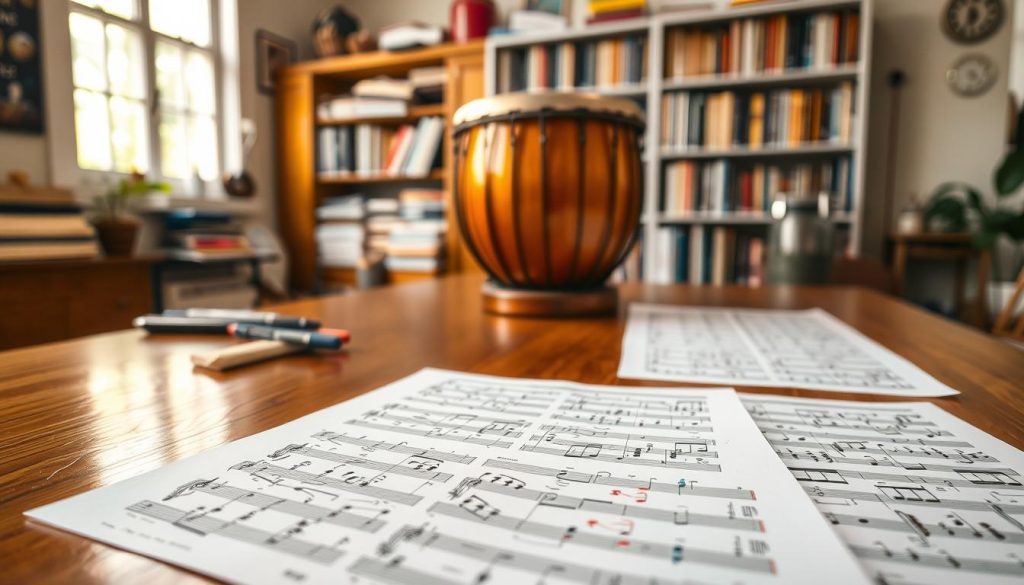
Learning to read sheet music opens up an exciting musical world. It lets you play melodies with confidence and accuracy. This section covers the key elements of reading music so you can progress quickly.
Symbols and note lengths
First, identify the time signature and beat. Set a metronome to a slow tempo and count the beats aloud. Then read the music one note at a time while keeping the beat. Here are some essential symbols:
- Dashes: Show that a note should be held longer.
- Vertical bars: Separate measures.
- Dots: Extend a note’s duration.
- Accents: Mark an emphasized beat.
A dot above or below a note indicates its octave. Parentheses group notes to play together, such as (13). A “0” or an empty space indicates a rest.
Understanding rhythm and tempo
To develop your sense of rhythm, start at 60 to 70 BPM. Play a passage correctly three times, then increase the tempo in 5 BPM steps. Alternate your left and right hands to build stamina and consistency.
It also helps to clap the rhythm before playing. A visual metronome can reduce timing differences by 40% and help you internalize the beat.
Rests and accents
Rests, shown as “0” or an empty space, are essential musical breaths. They shape the phrase and stabilize the rhythm. Accents add expression to your playing.
In short, reading the symbols helps organize your movements. Every mark on the page has a purpose and guides you toward a faithful, expressive performance.
Where can you find free tongue drum sheet music?
The internet is full of resources for people who enjoy this instrument. Beginners may find several sources especially useful, including songbooks supplied with a tongue drum and video tutorials on YouTube.
YouTube tutorials, particularly those using a visual “cascade” format, show hand placement in real time. This makes movements such as alternating hands easier to learn. Pinterest also offers many graphic diagrams for different instrument models.
Specialist sites such as TongueDrumSheetMusic.com and Freescores offer libraries organized by difficulty and musical style. Before downloading a piece, check that it includes a legend, clearly states the key and scale, and works with the number of notes on your instrument.

Downloadable PDFs are ideal for practicing offline. Some include links to complementary video tutorials, so you can use both formats together. The “Tongue Drum France” Facebook community, which has 15,000 members, also offers monthly creative challenges and mentoring. Beginners can learn from more experienced musicians.
Forums and discussion groups are good places to share versions adapted for common models. You can find practical solutions reviewed by other players. Always check your instrument’s scale before playing. A missing note can make a piece impossible to play, so compare the required notes with those on your tongue drum.
Regular webinars and local meetups offer opportunities to learn with others. They encourage enthusiasts to share resources and ideas. By combining these sources, you can build a personal library of reliable resources suited to your level.
| Resource type | Description |
|---|---|
| Specialist sites | Sheet music libraries organized by level and musical style. |
| Video tutorials | Real-time demonstrations of hand placement. |
| Free graphic diagrams with color codes. | |
| Downloadable PDFs | Offline practice resources, often with video links. |
| Facebook community | Monthly challenges and mentoring between musicians. |
| Forums | Sharing adapted versions and practical solutions. |
| Webinars | Opportunities to learn together and share resources. |
How do you choose a tongue drum for learning from sheet music?
Choosing the right instrument matters when you are learning. A suitable tongue drum makes sheet music easier to follow and playing more enjoyable. Here are a few factors to consider.
A suitable size and number of notes
Beginners are advised to start with an 8- or 11-note model in C major. These are less complex than a 15-note drum, making melodies easier to learn. Fewer tongues mean fewer positions to memorize, so you can master your first pieces sooner.
Material and sound quality for learning
The material of your instrument affects its sound. Titanium alloy is superior to carbon steel: it resists rust better, holds its tuning longer, and produces a clear sound with longer resonance. Carbon steel costs less, but it can produce an unpleasant metallic sound and needs regular care to prevent rust.
For children under eight, a 15 to 20 cm model is ideal. For older children and adults, a diameter of 25 to 30 cm is recommended for learning complete songs. Always check the instrument’s scale and key before buying to ensure it works with sheet music available online.
A well-chosen tongue drum can greatly improve your learning experience. Choose a model with numbers engraved on the tongues to make the notes easier to find and match to numbered notation.
In summary, simplicity and good sound quality help you progress. A suitable instrument lets you learn faster, enjoy playing from the start, and stay motivated to explore new melodies.
| Criterion | Recommendation |
|---|---|
| Number of notes | 8 or 11 notes in C major |
| Material | Titanium alloy for better sound |
| Size for children | 15 to 20 cm for children under eight |
| Size for adults | 25 to 30 cm for learning complete songs |
| Visual markings | Numbers engraved on the tongues |

Recommended equipment and accessories for playing from sheet music
The right equipment helps you get the most from your tongue drum. It makes learning easier and each practice session more enjoyable. Here are some accessories that can improve your playing.
Note marker stickers
Note marker stickers are especially useful for beginners. They create an immediate visual link between a note on the page and its tongue on the instrument. Apply them according to the manufacturer’s manual, check your instrument’s orientation, and test each note before your first session.
Remove the stickers gradually to strengthen your visual memory and play more independently.
Mallets or bare fingers
It is useful to compare playing with mallets and bare fingers. Mallets produce a clear, powerful sound and make accurate strikes easier at first. Fingers offer more control over dynamics and a richer resonance.
As you progress, practice with your fingers to improve dynamics, attack, and tone. Switch between mallets and fingers every 15 minutes to vary the sound and rest your hands.
Metronome and recording equipment
A metronome is essential for practicing tempo. It helps steady your rhythm and improve accuracy. A stable playing surface adds comfort, while a case helps you transport your instrument.
Recording sessions with a contact microphone or smartphone lets you analyze your playing, spot mistakes, and measure your progress more objectively.
Short, 20-minute sessions with a metronome and a recording are often more effective than long, unstructured sessions. You could also use the DrumTuner Pro app for tuning and the book L’Art du Tongue Drum to explore playing techniques in more depth.
Suitable equipment can turn a hesitant practice session into real progress. It reduces mistakes and makes practice more motivating, whether you are a beginner or an advanced musician.

Putting sheet music into practice: tips for beginners
Starting a new instrument can feel daunting, but a good approach makes learning exciting. These practical tips will help you make the most of your practice.
Break pieces into simple phrases
Breaking each piece into short phrases makes it easier to learn. Here is how:
- Isolate each measure: Practice one measure at a time.
- Work slowly: Use a metronome to maintain a steady tempo.
- Link measures gradually: Once you know each measure, combine two, then four, until you can play the whole piece.
Use a metronome to progress
A metronome helps develop your sense of rhythm. Try these steps:
- Play slowly: Start at a tempo that lets you play without mistakes.
- Increase the tempo in steps: Once you feel comfortable, raise it by 5 BPM.
- Play it correctly three times: Make sure you know the passage before speeding up.
Manage speed and mistakes
Handling mistakes well helps you keep the music moving. Try these strategies:
- Keep playing: If you make a mistake, continue to preserve the rhythm.
- Revisit difficult passages: Focus on troublesome sections during your next session.
- Practice the rebound: Strike the tongue without pressing on it; let the mallet or finger lift away for a clear sound.
Use the 20-minute daily practice method to structure your sessions:
- 5-minute warm-up: Practice simple scales.
- 10 minutes on a new piece: Focus on learning a new melody.
- 5-minute review: Revisit what you have learned to strengthen muscle memory.
Remember that consistency matters more than session length. Practicing for 20 minutes every day is better than having long, irregular weekend sessions. Celebrate small improvements: every measure you master and every successful tempo increase builds confidence.
For more information on reading music, see our article on how to read sheet music.
10 easy melodies to start playing on your tongue drum
Learning this instrument can be a rewarding adventure. These ten simple melodies will help you get to know it while having fun.
Classic examples
Classics such as “Frère Jacques” and “Happy Birthday” are ideal starting points. Their repeating patterns make them easier to learn.
- “Happy Birthday”: This song uses the pattern 1-1-2-1-4-3, played at 80 BPM. It is useful for practicing dynamics by alternating gentle and stronger strikes.
- “Frère Jacques”: Its repeating structure, 1-2-3-1 / 1-2-3-1 / 3-4-5 / 3-4-5, helps make left- and right-hand coordination automatic.
- “Au clair de la lune”: Practice this melody at 70 BPM. Its long, resonant notes develop listening and sound control.
- “Twinkle, Twinkle, Little Star”: The sequence 1 1 5 5 | 6 6 5 – | 4 4 3 3 | 2 2 1 – helps you connect musical phrases without pausing.
- “Amazing Grace”: This melody calls for a gentle touch, controlled rests, and careful note lengths to make the instrument sing expressively.
- Pentatonic lullaby: Ideal for improvising around a two- or three-note pattern, it uses the scale without the risk of a wrong note and develops creativity.
- Repeating folk tune: An excellent choice for practicing long-term memorization.
- Meditative melody: At a slow tempo, it lets you hear changes in tone depending on where you strike.
- Short rhythm exercise: Alternating hands over four beats helps build stamina.
- Creative variation: Rests, accents, and simple chords add interest to your playing.
Gradual learning techniques
To get the most from these melodies, listen to each piece first. Then hum it to remember the notes. Find each note on your instrument and play slowly, increasing the tempo little by little.
These melodies use no more than five to seven notes and serve different learning goals, from coordination to expression. Together, they offer a rounded and motivating way to progress.
Adapting sheet music to your tongue drum
Knowing how to adapt a melody to your instrument enriches your playing. First, identify your model’s scale and available notes. Sound each tongue and write down its note using numbers or letters. Then compare your list with the notes in the piece you want to adapt.
Identify the scale and available notes
Find the main melodic line: the notes that carry the tune. Remove fast ornaments and keep a steady rhythm. This preserves the essence of the piece while making it easier to play.
Transpose and simplify melodies
If your instrument lacks certain notes, move the phrase into an available range. An 8- or 9-note model may require substantial simplification, while a 15-note model allows you to stay closer to the original and use several octaves.
Replace complicated passages with their essential notes. If a chord is difficult, play it as an arpeggio, sounding its notes one after another.
Structure your own arrangements
Try an A-A-B-A structure for your arrangements: repeat a short section, play a contrasting passage, then return to the main melody. Add brief rests so the notes have time to ring.
Vary a repeating phrase with an accent, a rest, or a held note. Tools such as MuseScore can help you isolate the main parts of a complex score, while Chordify automatically generates simplified chord charts.
Write down your arrangements to build a repertoire suited to your instrument. Over time, this will help you develop your own style. Adapting sheet music can itself become a creative opportunity: every instrument has its own voice, and your arrangements let you explore it.
Exercises for progressing quickly with free sheet music
Focused exercises help you move forward. They strengthen coordination and improve rhythmic accuracy. Here are practical ways to make the most of your sessions.
Hand-eye coordination and rhythmic accuracy
Coordination between your hands and eyes is crucial. To improve it, follow the sheet music while anticipating your next movement. Play simple patterns with your eyes on the notation. This strengthens the connection between seeing and moving and makes melodies easier to perform.
Finger exercises and alternating hands
Alternate your left and right hands on a short pattern for about three minutes. This builds smooth, balanced coordination. Switch between mallets and fingers to change the tone and give your joints a break. Practice the rebound too: strike a tongue without pressing down, allowing the mallet or finger to lift away for a clear sound.
An effective practice routine (the 20-minute method)
A structured 20-minute routine can transform your practice. Divide the time as follows:
- Warm-up: 2 to 3 minutes of breathing and slow strikes.
- Slow reading: 10 minutes practicing a phrase with a metronome.
- Playing through: 5 minutes connecting the phrases.
- Brief review: 2 minutes noting your progress and what needs work.
Add focused exercises, such as playing triplets on offbeats for five minutes. You can also play with your eyes closed for two minutes to develop touch memory. Record your sessions: doing so turns each mistake into a chance to learn and, according to a Berklee College study, improves accuracy by 40%.
Switching between mallets and fingers every 15 minutes varies the sound and rests your joints. For difficult measures, break them into sections, practice each alone, then return them to the full piece. This helps you master each part without frustration.
Focused exercises and a daily 20-minute routine will help you progress quickly. Make each session a measurable step toward mastering your instrument. For more learning advice, see our article on the best free sheet music.
Solving common problems when reading and playing sheet music
Identifying common difficulties can make playing melodies more enjoyable. Musicians often encounter wrong notes, an unsteady rhythm, or physical discomfort. Here are practical ways to address them.
Wrong notes and visual recognition
To avoid mistakes, check that the number on the page matches the tongue you strike. Play each note separately to identify visual mistakes. If you struggle to remember the notes, temporarily put stickers back on the tongues. They will make reading easier.
Pay attention to the octave as well. A note played one octave too high or low will sound wrong even if its number is correct. Look for dots above or below the numbers on the page.
Unsteady rhythm and tempo control
An unsteady rhythm can disrupt your playing. Use a metronome and count the beats aloud. Isolate a difficult measure and practice it slowly. Then link two measures, followed by four.
To internalize the beat, clap the rhythm before playing it on your instrument. This helps reduce timing differences.
Pain and fatigue: posture and alternation
Pain in your fingers and hands can develop if you neglect your posture. Strike more gently and sit comfortably. Keep the instrument stable and your shoulders relaxed.
Alternate between mallets and fingers every 15 minutes to rest your hands. Warm up before each session with rolling movements and stretches.
According to the Institute of Arts Medicine, tilting a tongue drum at 45° can reduce musculoskeletal problems by 60%. Take regular breaks and stop immediately if sharp pain persists.
Most common problems improve when you identify the difficulty, return to the basics, and practice each piece patiently and gradually. These methods can improve your playing and help you enjoy the experience.
Conclusion: your guide to finding and using free tongue drum sheet music
Every melody you play helps you gain skills and express yourself. This guide has introduced key methods for progressing with suitable resources. By exploring the instrument, learning to read notes, and discovering ten simple melodies, you have a strong starting point.
To keep learning, choose two pieces to practice regularly with a metronome. Record yourself to measure your progress and build confidence. Adapt pieces to your instrument by adding rests or accents: this enriches your playing while keeping the music easy to read.
Explore reliable resources such as downloadable PDFs and online communities to expand your repertoire. Set simple goals and celebrate each improvement. With regular practice, your instrument will become a way to express yourself through music. Your musical journey is just beginning: pick up your mallets and play!