
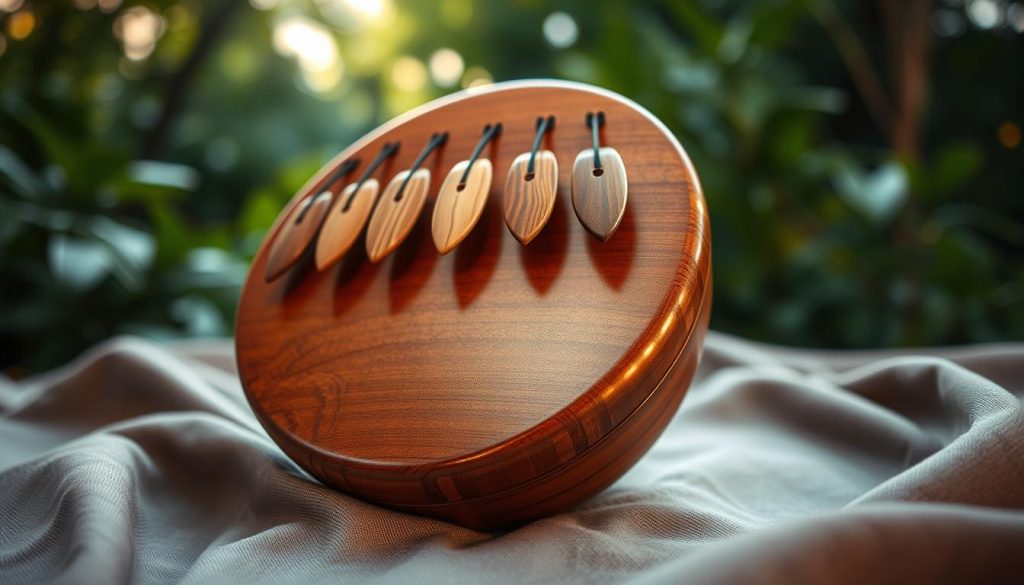
The tongue drum is a fascinating percussion instrument that is attracting more and more musicians around the world. Its distinctive flying saucer shape is only one of the things that makes it special. This drum produces soothing sounds that are ideal for meditation and relaxation.
Invented in 2007 by Dennis Havlena, this instrument was made from a steel propane tank. Its metal tongues vibrate when struck, creating melodic notes. This makes the tongue drum accessible even to beginners, as it is almost impossible to play a wrong note.
In this article, we will explore the features of this instrument and see why it has become a favorite in wellness music. Get ready to discover the captivating world of the tongue drum!
Introduction to the tongue drum: definition and overview
This melodic drum stands out for its distinctive design. It consists of two metal shells welded together to form an enclosed resonating chamber. On the upper surface, tongues are cut directly into the metal in a precise pattern. These cuts allow each tongue to vibrate freely when struck.
Underneath, a small circular opening serves as a sound hole. It projects the harmonics outward and gives the sound its characteristic soft, enveloping resonance. The name “tongue” refers to the metal pieces that vibrate to produce distinct, harmonious sounds.
Most tongue drums are made of steel, chosen for its strength and excellent sound resonance. They come in many sizes, from pocket-sized models measuring 11.5 cm in diameter to larger versions measuring 30 cm or more.
Here is a summary of their main features:
| Feature | Details |
|---|---|
| Construction | Two welded metal shells |
| Cutouts | Tongues cut to vibrate |
| Sound hole | Circular opening for resonance |
| Material | Steel, for durability and sound quality |
| Size | From 11.5 cm to 30 cm or more |
This drum belongs to the family of melodic percussion instruments, alongside the handpan and steelpan. Its construction is more accessible, however, and its price is more affordable. It can be played with the fingers or mallets, giving players at every level plenty of ways to express themselves.
History and origins of the tongue drum
The roots of this fascinating instrument reach back to older traditions. Ancestral instruments such as the slit drum played an important role in its development. Used for more than 500 years, slit drums are made from hollowed-out tree trunks. They appear in cultures across Africa, Polynesia and South America.
Another important example is the steelpan, which emerged in Trinidad and Tobago in the 1930s. Made from repurposed oil drums, this instrument also influenced the design of early tongue drums. The handpan, invented in 1999, attracted worldwide interest. Its popularity prompted Dennis Havlena to look for a more affordable alternative for music enthusiasts.
Early inspirations: slit drums, steelpans and other instruments
The whale drum, created by Jim Doble in 1990 from used gas tanks, also inspired some handmade designs. The tambiro developed by Dominican percussionist Fellé Vega directly influenced Havlena when he made his own instrument.
Dennis Havlena’s modern invention in 2007
In 2007, Dennis Havlena cut eight tongues into a steel propane tank, creating the first hank drum. Neodymium magnets were placed beneath the notes to enhance vibrations and help with tuning. This innovation marked a turning point in tongue drum making.
How the tongue drum spread around the world
The 2010s were decisive for the popularity of this instrument. Through platforms such as YouTube, Instagram and TikTok, musicians including Hang Massive and Daniel Waples shared captivating performances. These clips attracted millions of views and brought the tongue drum to a worldwide audience.
Its growing popularity also highlighted cultural differences in how the instrument is used. In Africa, it is often played at traditional ceremonies. In Europe and the Americas, it has found a place in yoga and music therapy. In Asia, it accompanies meditation in temples.
Recent technical innovations, including added strings and electrically amplified models, have expanded its musical possibilities. Today, the tongue drum continues to evolve and attract new enthusiasts around the world.
How the instrument works and how it is made
The design of this instrument is fascinating and relies on precise acoustic principles. Its body consists of two welded metal shells that form an enclosed resonating chamber. On the upper surface, tongues are carefully cut into the metal in a specific geometric pattern. Each tongue can then vibrate freely when struck.
Underneath, a small circular opening acts as a sound hole. It projects the harmonics outward, giving the instrument its soft, enveloping resonance. Steel is commonly used because it balances strength, durability and sound quality.

Structure and materials
Cutting the tongues is an extremely precise process. Each tongue has a specific length so that it produces the intended note in the chosen scale. The thickness of the steel sheet directly affects the instrument’s tone. Thicker steel produces a lower, deeper sound, while thinner steel produces higher notes.
Some premium models use specially treated steel to improve resonance. This can produce richer, more nuanced sounds and enhance the player’s experience.
Scales and numbers of notes
The number of tongues generally ranges from 6 to 13. Eight-tongue models can span a full octave. Most tongue drums use a pentatonic scale, with 5 notes per octave. This makes the instrument approachable for beginners because it is almost impossible to play a wrong note.
Other models use a diatonic scale, offering 7 notes and more melodic possibilities. Playing and learning them requires a little more precision.
How size and thickness affect the sound
The instrument’s size plays a major role in its pitch range. A small model measuring 11.5 cm in diameter produces high notes, while a large 30 cm model produces deep, low notes. The shape of the playing surface and the arrangement of the tongues also affect sound quality and playability.
In short, the instrument’s construction and design are essential to its harmonious, pleasing sound. Its tuning is set during manufacture, and neodymium magnets can be placed beneath the notes to enhance vibrations and fine-tune their pitch. These features also open the way to electroacoustic models suited to different musical settings.
| Feature | Details |
|---|---|
| Material | Steel |
| Structure | Two welded shells |
| Number of tongues | 6 to 13 |
| Scale | Pentatonic or diatonic |
| Size | 11.5 cm to 30 cm |
| Steel thickness | Affects the tone |
Tongue drum names, models and variations
In the world of percussion, this instrument goes by many names. Each refers to a variation of the same fascinating instrument. Here is an overview of the names and models you may encounter.
Hank drum, tank drum, steel tongue drum and other names
“Hank drum” is the name used by Dennis Havlena, the creator of this instrument. It combines “hang” and “tank,” referring to its shape and original material. “Tank drum” likewise recalls the first models made from recycled steel propane tanks.
The French name “tambour à langues” translates literally as “tongue drum.” Other names, including “steel tongue drum” and “vibe drum,” are also used for variations of the same instrument.
Different models: shapes, sizes and configurations
Tongue drums vary considerably in size and shape, from miniature models measuring 11.5 cm in diameter to larger versions measuring 30 cm or more. Here are a few points to consider:
- Eight-tongue models are the most common and can span a full octave.
- Eleven- or thirteen-tongue versions offer more harmonic possibilities for advanced musicians.
- Most tongue drums use a pentatonic scale, making them approachable for beginners.
- Manufacturers offer several shapes, including the classic saucer, a rounded bulb and a compact pocket model.
Although these instruments may look similar, they differ in construction, price and playing technique. Musicians can choose a model that suits their style and needs.
Playing techniques and practical use
Learning a few playing techniques helps you get the most from this instrument. Musicians can use different approaches to express their creativity and musical ideas.
Playing with your fingers or mallets
Playing with your fingers is the most natural and common technique. Strike the tongues with slightly curved fingertips. The ideal striking point is about one third of the tongue’s length from its free end. Avoid striking with a fingernail, which produces an overly metallic, dry sound. Pressing with the whole pad of your finger can also dampen the resonance.
Tongue drums often come with two small, soft-headed mallets. They produce a fuller, gentler sound, well suited to relaxation sessions or group activities.
Advanced techniques: damping and polyrhythm
For musicians who want to develop their playing, damping is a useful technique. Lightly touch a tongue just after striking it to stop its vibration. This keeps the harmonics of several notes from overlapping.
By alternating your hands across different tongues, you can create complex rhythmic patterns and explore polyrhythm. This approach greatly expands the musical possibilities.
Playing positions and acoustics
You can play a tongue drum on a table, on your lap or while holding it in your hands. Each position affects its acoustics. A hard surface reinforces lower frequencies, while holding the instrument produces a more direct, precise sound.
The sound changes with the supporting surface. A hard surface boosts the bass, while a softer support such as your lap produces a more muted sound.
When starting out, explore all the tongues freely without trying to play a particular melody. Move from note to note to become familiar with the sounds.
You can also use adapted sheet music, such as the ColorZik system, which assigns colors to notes. This makes melodies easier to learn without reading conventional notation.
Finally, draw inspiration from musicians such as Daniel Waples, whose improvisations on the tongue drum have captivated a generation of players.
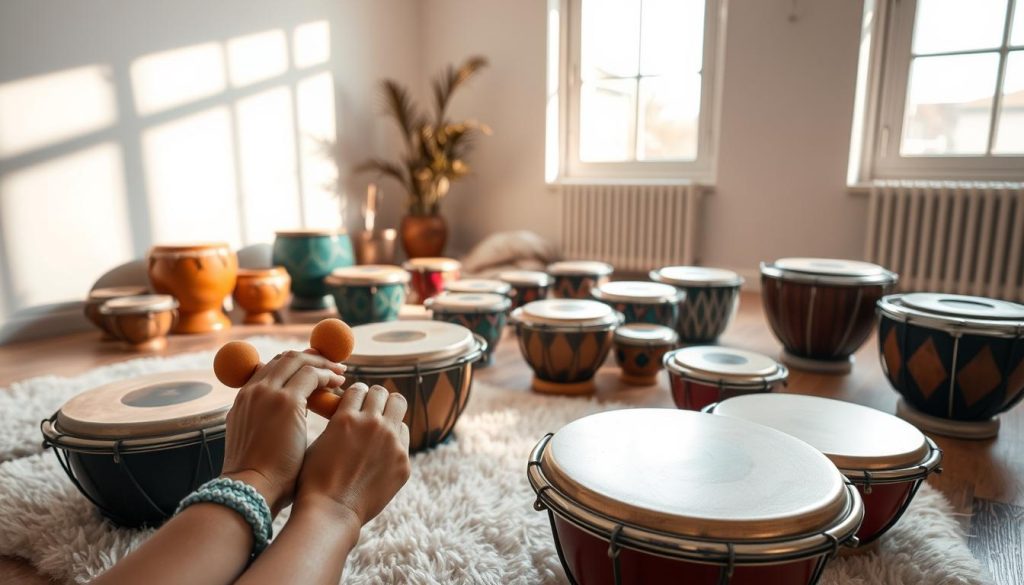
Musical and cultural settings
The tongue drum is used for much more than musical performances. This instrument has found a place in settings ranging from meditative music to education.
Meditative music, new age and relaxation
This drum is especially popular in meditative and new age music. Its gentle tones fit naturally with mindfulness, yoga and relaxation practices. Its soothing vibrations help create an atmosphere for deep relaxation.
Education, group activities and music therapy
In education, this instrument is well suited to introducing children to music. Children as young as 3 or 4 can explore its sounds without pressure. Teachers value its portability and the ease of using it with groups without electricity.
In residential care homes, its gentle tones can encourage concentration and interaction among older people, including those with cognitive difficulties. Music therapists also use it in relaxation and meditation sessions.
Its place in cultures around the world
The tongue drum has a place in a variety of cultural settings. In Africa, it is often used in traditional ceremonies alongside dancing and singing. In Europe and the Americas, it is used by yoga practitioners and in music therapy.
In Asia, it can be found in temples and meditation centers, where it helps create an atmosphere conducive to deep relaxation. Paired with percussion instruments such as the djembe or cajón, it also fits into world music ensembles.
Many musicians appreciate its adaptability across styles, from classical music and jazz to contemporary compositions. This instrument continues to inspire and enrich music around the world.

What Is a Tongue Drum and How Does It Work? — A Closer Look
This instrument works through fascinating acoustic principles. Each metal tongue vibrates at a particular frequency determined by its length, width and the thickness of the metal. Those vibrations produce the melodic sounds associated with the instrument.
Acoustics and sound production
The resonating chamber formed by the two welded shells plays a crucial role. It amplifies the tongues’ vibrations and projects sound outward through the hole beneath the instrument. The result is a characteristic sound rich in harmonics and especially enveloping.
How vibration, resonance and tuning interact
Tuning is a precise process completed during manufacture. Each tongue’s length and thickness determine the note it produces. Neodymium magnets placed beneath the tongues can also refine the tuning and enhance vibration for better sound quality.
Unlike instruments such as the guitar or piano, this instrument does not need regular retuning. A hard impact can, however, put it slightly out of tune and may require the help of a specialist instrument maker.
A tongue drum’s notes sustain and fill the surrounding space. This distinguishes it from the xylophone or metallophone, which produce drier, more directional sounds. Over time, the steel settles and the instrument develops a tonal character that enriches its natural harmonics.
To learn more about how this instrument works, you can consult additional resources on tongue drums.
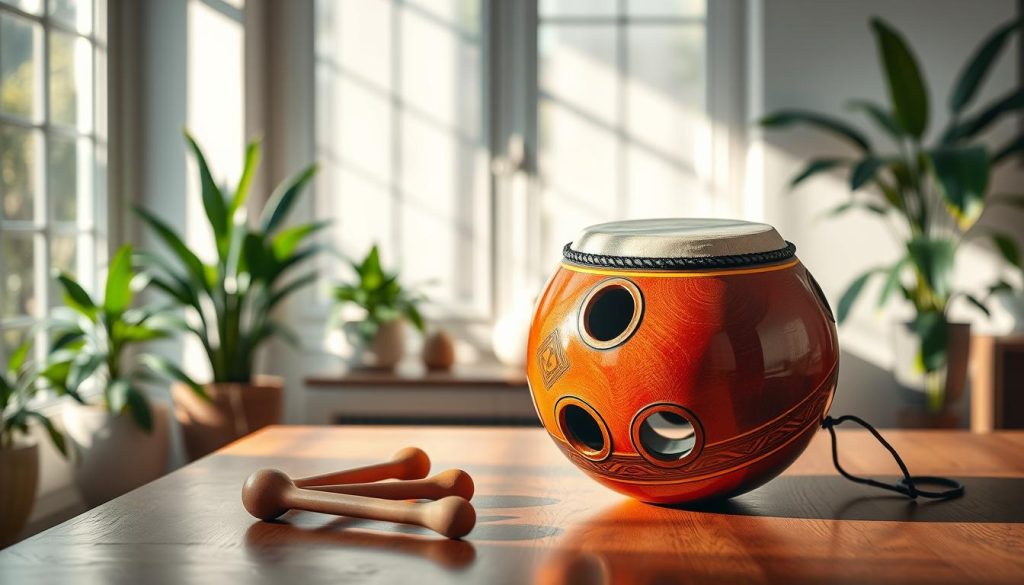
Benefits of the tongue drum for body and mind
Regularly playing this percussion instrument can support physical and mental well-being. Its soothing sounds and simple playing technique can have a relaxing effect, especially for people experiencing stress and anxiety.
Reducing stress and anxiety
Regular tongue drum practice may help reduce stress and anxiety. A 2014 University of Vermont study found that playing an instrument can reduce the effects of cortisol, a stress hormone, on the brain. Its gentle sounds can help release tension and restore a sense of calm.
Improving sleep
Playing a few tongue drum melodies just before bed can help you wind down. This relaxing activity replaces screen time with a meditative practice and may help ease the stress accumulated during the day.
Developing concentration, memory and coordination
Scientific studies show that learning an instrument affects areas of the brain involved in concentration. This may help musicians focus on everyday tasks. A 2020 Chilean study also found that people who had played an instrument for more than 2 years showed stronger cognitive abilities.
Encouraging creativity and cognitive skills
The tongue drum encourages creativity by letting musicians compose their own pieces. This exercise can develop the ability to find new solutions to everyday problems. Music therapy also uses the instrument to help older people maintain coordination and younger people develop it.
Try meditating with a tongue drum: this calming practice can reinforce the instrument’s relaxing effect. You can enjoy its benefits whether you follow sheet music or improvise freely.
Choosing, caring for and enjoying your tongue drum
Choosing the right instrument and caring for it will help you get the most from your musical experience. Here are some practical tips.
Key considerations when choosing an instrument
For children and beginners, consider a compact 8- to 12-inch model that is easier to handle and learn on. For group activities, a larger model of 12 inches or more produces a fuller, more resonant sound.
The number of notes also matters. An eight-note tongue drum covers a full octave, enough for most simple melodies. More advanced musicians may prefer an 11- to 13-note model for greater harmonic range.
Finally, choose a scale that suits your intended use. A pentatonic scale is ideal for beginners and therapeutic settings because it is almost impossible to play a wrong note. A diatonic scale better suits musicians who want to explore a wider, more specific repertoire.
Cleaning and storing your tongue drum
Regular care helps preserve your instrument’s quality. Wipe it with a dry cloth after each use to prevent dust from building up. Steel can rust when exposed to moisture, so avoid storing the drum somewhere damp or playing it with wet hands.
Use the supplied case to protect your tongue drum from impacts, dust and temperature changes. Avoid leaving it in direct sunlight, especially in summer, to prevent warping or changes to its sound.
Essential accessories: mallets, case and sheet music
Make sure your tongue drum comes with its essential accessories. Soft-headed mallets are recommended for a gentler, fuller sound. Check them regularly and replace them if their covering starts to come loose.
Adapted sheet music, such as the ColorZik system that links colors to notes, makes melodies easier to learn visually without mastering conventional notation. It makes learning more accessible and enjoyable.
To explore the different models and their features, read this complete guide to tongue drums.
Conclusion
In just a few years, the tongue drum has become an accessible, versatile instrument. It is more than a toy: it can bring music into everyday life. Whether you want to lead an activity with older adults, introduce children to sound or accompany a meditation practice, this instrument has much to offer.
Its rich sound and ease of learning make it a valuable tool for well-being. The tongue drum offers endless opportunities for musical exploration and personal expression. Its soothing tones can contribute to relaxation and personal fulfillment.
Why wait? Join the community of enthusiasts and begin your musical journey today.