

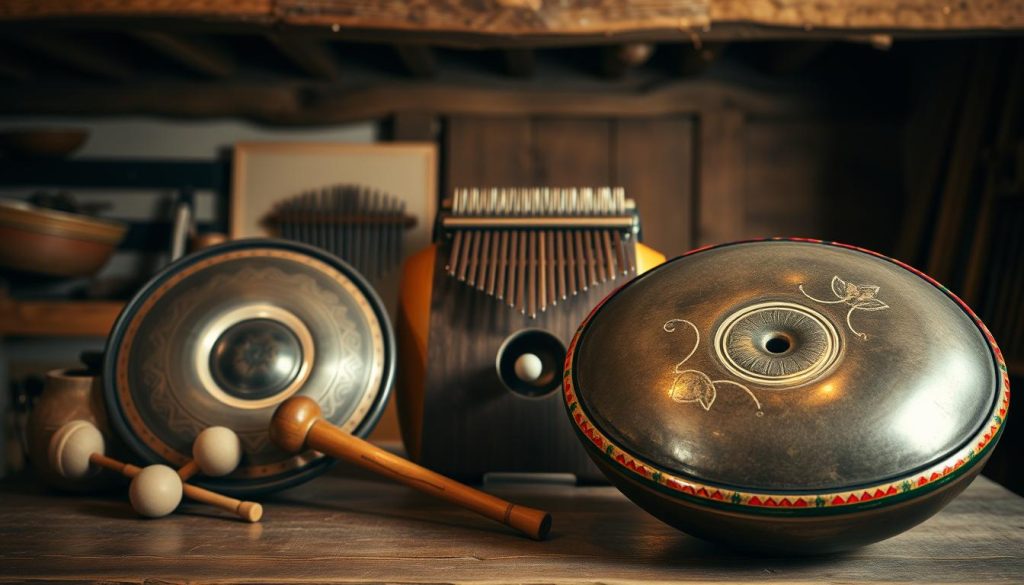
The tongue drum is a fascinating percussion musical instrument invented in 2007 by Dennis Havlena. This American inventor wanted to offer an affordable alternative to the handpan, which had become very expensive. With its distinctive flying-saucer shape, the instrument immediately arouses curiosity.
The tongues cut into its surface, which resemble human tongues, give it its name. Although the tongue drum is a modern instrument, it belongs to a lineage of ancient instruments. Its predecessors, such as slit drums, have been used in cultures around the world.
Today, this instrument is popular for activities such as meditation and yoga, as well as musical genres such as jazz. Thanks to its pentatonic scales, it is accessible to everyone and lets anyone make music without worrying about wrong notes.
Introducing the tongue drum: a fascinating modern instrument
This modern percussion instrument captivates listeners with its simplicity and sound. It consists of two welded metal shells that form a closed resonating chamber. Tongues are cut into the metal of its upper surface in a specific pattern. A small circular opening serves as a sound hole, projecting the overtones outward.
The instrument is played with the fingers or soft-headed mallets. Most available models are tuned to a pentatonic scale, making harmonious improvisation easy. Even a beginner can create captivating melodies.
General description of the instrument
- Appearance: a flying-saucer shape with cut-out tongues and a circular sound hole.
- How it works: each tongue vibrates freely and produces a note according to its length and thickness.
- Various sizes: from pocket models measuring about 11.5 cm to 30 cm models, with size affecting the instrument’s range.
- Number of tongues: usually between 6 and 13, with eight-note models the most common.
- Accessibility: thanks to the pentatonic scale, anyone can quickly produce harmonious sounds.
Popularity and contemporary uses
The instrument’s popularity has soared thanks to social media. Artists such as Hang Massive and Daniel Waples have shared performances that captivated millions of viewers. Today, the instrument is used in settings ranging from schools and yoga centers to music therapy.
Its vibrations create a distinctive sensory experience that encourages a close connection with the instrument. Often sold with a beginner’s guide, mallets and a protective case, it is ready to play as soon as it is purchased.
In short, this recent instrument has won a worldwide audience through its ease of use and beautiful sound.
The tongue drum’s predecessors
The roots of this modern instrument reach deep into music history. Among its most notable predecessors, the slit drum stands out as an important cultural instrument. Made from a hollowed-out tree trunk, it has carefully carved slits. By striking different areas, a player produces a variety of sounds, revealing its remarkable acoustic range.
Archaeological evidence shows that slit drums have existed for at least 500 years. They have been found on several continents, including in Africa, the Philippines and Polynesia, and among the Aztecs in Mexico, where the instrument was known as the “teponaztli.” This geographical diversity highlights the instrument‘s importance in music around the world.
Modern versions, often called “log drums” or “wood drums,” have wooden tongues. These contemporary slit drums use the same principle as the tongue drum while giving musicians other acoustic possibilities.
The slit drum (log drum): an ancient legacy
The slit drum is perhaps the tongue drum’s oldest predecessor. It has endured through the centuries and continues to inspire many artists. Its simple but effective construction makes it possible to explore distinctive sounds. By striking its slits, musicians can express their creativity, making this instrument a powerful means of conveying emotion.
The Whale Drum: bringing metal to slit percussion
In 1990, Jim Doble brought a new approach to percussion with the Whale Drum. Made from large gas cylinders, this innovative instrument produces deep sounds reminiscent of whale song. Although it is untuned, it was mainly used in kindergartens to engage young children’s senses. The drum paved the way for using metal in slit percussion instruments.
The handpan: a close relative and source of inspiration
The handpan, created in 1999 by Felix Rohner and Sabina Schärer, is another milestone in the history of percussion instruments. Made from two welded convex shells, it produces harmonious notes without cut-out tongues. Despite its rapid success, its high price, sometimes reaching €10,000, prompted Dennis Havlena to seek a more affordable alternative. That search led to the creation of the tongue drum.
The Tambiro: the Dominican precursor
In 2005, Fellé Vega invented the Tambiro, an instrument that directly inspired Havlena. Made from a small gas cylinder, it has notches of different sizes that produce a variety of sounds when struck with the hands. Although it was never sold commercially, the Tambiro was a crucial step toward more accessible instruments.
In short, the connection between these instruments is clear. From wooden slit drums to modern metal versions, each step contributed to the emergence of the tongue drum. As the saying goes, “music is the language of emotion,” and these instruments are living proof.
Dennis Havlena and the invention of the tongue drum in 2007
In 2007, Dennis Havlena, an inventor passionate about percussion instruments, began an ambitious project. He was fascinated by the handpan but faced a major obstacle: its exorbitant price, which sometimes reached €10,000 on platforms such as eBay. This led him to look for a more affordable alternative.
Unable to buy a handpan, Havlena took inspiration from Fellé Vega’s Tambiro. He decided to make an instrument from a steel propane tank. He placed the cut-outs on top, making the notes easier to reach. The result was an eight-note prototype spanning two octaves.
The context and the search for an affordable alternative to the handpan
Dennis Havlena was driven by a desire to create an instrument everyone could access. He wanted to offer a rewarding musical experience without price being a barrier. His project aimed to let more musicians explore their creativity without financial constraints.
The manufacturing process and technical innovations
Havlena introduced a major innovation to the manufacturing process. By placing neodymium magnets beneath the cut-out tongues, he was able to amplify their vibrations and fine-tune each note. This technique, still used today, helps produce exceptional sound quality.
The first prototype, unveiled in February 2007, marked a significant advance in melodic percussion. It quickly won over musicians and hobbyists, encouraging them to build their own instruments.
Sharing the plans freely and the rise of commercial production
Eager to share his invention, Dennis Havlena made the instrument’s plans freely available on specialist forums and his personal website. By choosing not to patent it, he allowed makers around the world to adopt the concept. This opened the way to varied commercial production, with enhanced models and attractive designs.
The name “tongue drum” gradually took hold, replacing the original name “tank drum” because of the shape of the cut-outs. Thanks to Dennis Havlena’s vision and generosity, the instrument became accessible to everyone, marking a turning point in the history of melodic percussion.
Why is it called a “tongue drum”? Other names for the instrument
The name “tongue drum” comes from the distinctive shape of the cuts Dennis Havlena made in the gas cylinder. They resemble human tongues, hence the English word “tongue.” In French, the name could be translated as “tambour à langues,” but that term is rarely used. Musicians and enthusiasts generally prefer the English name.
Dennis Havlena initially considered calling his invention a “tank drum,” referring to the gas cylinder from which he made it. During a discussion on a handpan forum, a user named “Cheapbastid” suggested “hank drum,” a blend of “Hang” (another name for the handpan) and “tank.” That name is still mentioned on Havlena’s official website.
Other names used by players and brands
Besides “tongue drum,” several other names are used. “Vibe drum,” for example, emphasizes the vibrations it produces, while “zen drum” and “chakra drum” highlight its use in meditation practices. Some models are also called “steel tongue drums” to indicate that they are made of steel.
Brands have contributed greatly to the variety of names for this instrument. At times, this has caused confusion among potential buyers. Tongue shapes have also evolved since the original prototype. Today, square, round and hexagonal cut-outs may no longer look like tongues, but that does not affect their acoustic quality.
Despite this variety, all these names refer to the same instrument. Knowing them can help when researching or shopping online. “Tongue drum” became the standard name because it describes the instrument better than “hank drum” or “tank drum,” especially now that modern models are no longer made from gas cylinders.
Ultimately, the range of names reflects the instrument’s growing popularity. It is appreciated by many communities of musicians around the world.
| Name | Description |
|---|---|
| Tongue drum | The most common name, referring to the shape of the cut-outs. |
| Tambour à langues | A little-used literal French translation. |
| Tank drum | The original name proposed by Dennis Havlena. |
| Hank drum | A name suggested by a forum user, combining Hang and tank. |
| Vibe drum | Emphasizes the vibrations produced by the instrument. |
| Zen drum | Used in meditation practices. |
| Steel tongue drum | Indicates that the instrument is made of steel. |
The tongue drum’s technical and cultural evolution
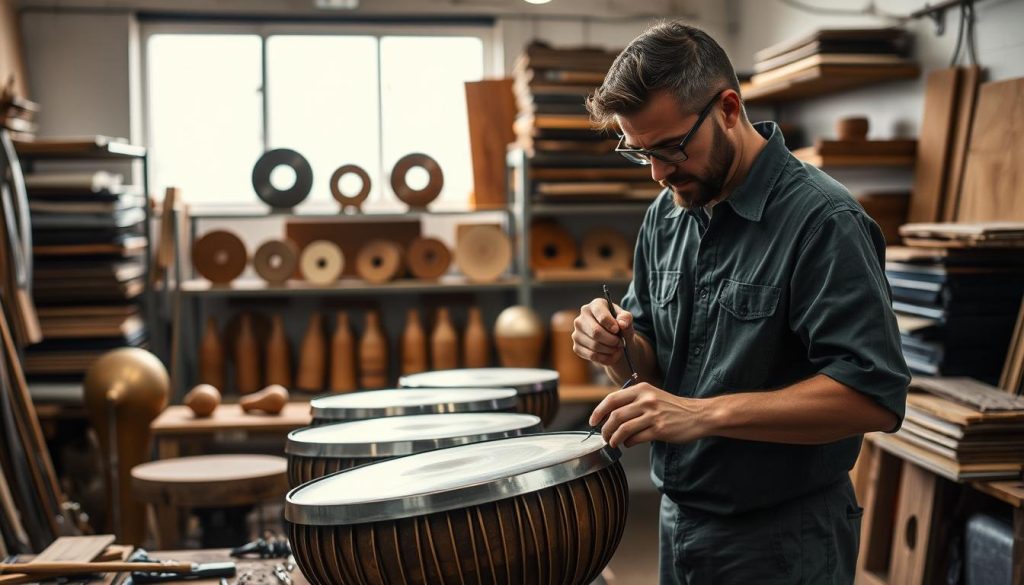
Since its beginnings, this instrument has undergone a remarkable transformation. Early models were made from recycled steel gas cylinders. Manufacturing has since evolved: today’s makers use steel selected for its strength and ability to produce clear, melodic resonance.
The thickness of the metal sheet plays a crucial role in the sound’s timbre. Thicker steel produces lower, deeper notes, while thinner steel produces higher sounds. Musicians can therefore choose an instrument suited to their style.
Modern innovations and a variety of models
Today’s models come in different sizes, from pocket-sized mini tongue drums measuring about 11.5 cm to instruments 30 cm or more in diameter. The number of tongues ranges from 6 to 13, with eight-note models the most widespread.
Most instruments are tuned to a pentatonic scale, which makes improvisation easier. Some models also offer a diatonic scale, providing more melodic possibilities. Recent innovations, such as added strings and electric amplification on certain models, have further enriched their sound.
Uses across cultures and world music
The tongue drum has found a place in many cultures. In Africa, it is often used in traditional ceremonies, while in Europe and the Americas it is used in yoga and sound therapy. In Asia, the instrument can be found in temples and meditation centers.
Its versatility lets it suit musical styles from new age and jazz to contemporary classical music. Thanks to today’s manufacturing quality, these instruments offer long resonance and enveloping vibrations that encourage relaxation and introspection.
In short, this instrument‘s technical and cultural evolution shows its ability to meet the needs of musicians worldwide while preserving the essence of Dennis Havlena’s original invention.
The tongue drum: its origin, history and evolution in music and meditation
Over the years, this instrument has found a place in many musical practices. Its uses span new age music, jazz and contemporary classical music. Artists such as Manu Delago, who has collaborated with Björk, have incorporated the distinctive sounds of metal-tined instruments into modern compositions.
Use in different musical practices
- In new age music, its soothing, ethereal sounds have made it a favorite.
- In jazz, it brings an original touch that enriches improvisation.
- Contemporary classical music also benefits from its use, as illustrated by the collaboration between Manu Delago and Björk.
Social media has played a crucial role in popularizing this instrument. Musicians such as Hang Massive and Daniel Waples have captivated millions with their outdoor performances, accumulating hundreds of millions of views on platforms such as YouTube.
Use in meditation, relaxation and sound therapies
In meditation and relaxation, this instrument has become a recognized therapeutic tool. Its gentle, enveloping sounds create an atmosphere conducive to introspection and mindfulness. In Indian culture in particular, it is used to open the chakras.
The tongue drum is also popular in sophrology, yoga and guided relaxation sessions. Its ability to induce a state of deep calm makes it suitable for older adults, including those with cognitive impairments.
Here are a few key points about its use:
- It stimulates motor coordination and encourages concentration.
- It creates opportunities for group interaction, particularly in residential care homes for older adults.
- The pentatonic scale allows free improvisation and makes music accessible to everyone.
The tongue drum is a musical instrument suited to both individual playing and group activities. Several instruments tuned to the same scale can be played together without dissonance.
The melodies produced by this instrument feel enveloping because the notes resonate for so long. That makes it an ideal choice for sound relaxation sessions and sound baths.
In conclusion, the tongue drum is much more than a simple musical instrument. It is a tool for well-being that has found a place in meditation and relaxation practices around the world.
Comparison with related instruments
Exploring the similarities and differences between the tongue drum and other percussion instruments helps clarify what makes each one distinctive.
Tongue drum vs. handpan: key similarities and differences
Tongue drums and handpans are often confused because of their similar shapes. Their construction, however, differs considerably. The handpan is made from nitrided steel, hammered by hand, with no cut-outs. It is played with the hands while suspended between the knees.
The tongue drum is more accessible. It is manufactured industrially, with tongue-shaped cuts made in a sheet of steel. It can rest on a table or the player’s lap and is played with the fingers or mallets. In terms of price, a handpan can cost several thousand euros, while entry-level tongue drums are available from around twenty euros.
Tongue drum vs. kalimba: two instruments with distinct sounds
The kalimba also has metal tines, but it is small and played with the thumbs. Its sound is high and intimate, whereas the tongue drum offers much greater depth and resonance. Although the two instruments differ, they can complement each other. The kalimba is better suited to delicate solo melodies, while the tongue drum is ideal for creating immersive soundscapes and accompanying group activities.
Tongue drum vs. xylophone and metallophone: resonance and uses
Xylophones and metallophones produce drier, more direct sounds with little resonance. The tongue drum, by contrast, sustains its notes and creates a soundscape suited to relaxation. For meditation and relaxation, the tongue drum has a clear advantage. For precise work on pitch and reading music, a metallophone may be preferable.
Often tuned to a pentatonic scale, the tongue drum offers a musical experience free of wrong notes. Xylophones and metallophones require some technique to avoid dissonance.
Several factors can help you make an informed choice:
- Budget: the tongue drum is generally more affordable.
- Intended use: leisure, therapy or music education.
- Players: children, adults or older adults.
- Desired sound: immersion or precision.
In conclusion, the tongue drum occupies a unique place among melodic percussion instruments. It offers an appealing balance of affordability, ease of playing and rich sound.
| Instrument | Characteristics | Best suited to |
|---|---|---|
| Tongue drum | Cut-out tongues; gentle, enveloping sound | Meditation, relaxation, group activities |
| Handpan | Hand-hammered; clear, bright sound | Complex playing, varied performances |
| Kalimba | Small size; high, intimate sound | Delicate solo melodies |
| Xylophone | Dry, direct sounds | Music education, precise playing |
| Metallophone | Little resonance; direct sounds | Reading music, working on pitch |
Conclusion: an accessible, captivating instrument with a growing audience
In just a few years, this instrument has captivated a wide audience thanks to its simplicity and accessibility. From meditation to introducing children to music, it has a place in many activities. Whether you are a beginner or an experienced musician, there is a model to suit your needs.
Prices range from around twenty euros for entry-level models to about €160 for professional versions. Most instruments come with a beginner’s guide, mallets and a protective case, making them easy to start using.
This instrument continues to evolve and gain popularity around the world. Join the growing community of enthusiasts and explore the enchanting melodies it offers. Let its vibrations carry you into a unique musical experience.