
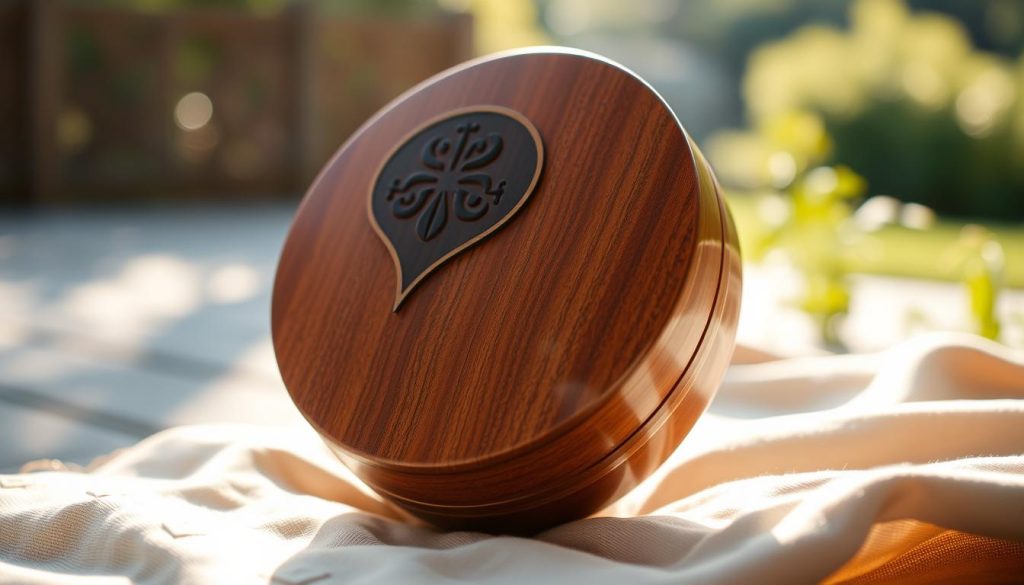
The tongue drum is a captivating percussion instrument that is attracting growing interest among people interested in well-being and meditation. This article helps readers find their ideal tongue drum by exploring the essential factors to consider.
The tuning frequency of 432 Hz is often the subject of debate. Some musicians believe it benefits the body and mind, while others remain skeptical. The international reference pitch for tuning musical instruments is 440 Hz; tuning to 432 Hz gives a slightly lower pitch.
This guide covers eight key factors, including the number of tongues, size, and material. The audible difference between the two tuning frequencies is subtle, so your choice will mainly depend on how you intend to use the instrument.
Ultimately, a considered purchase based on your own needs will help you avoid disappointment. Read on to discover everything you should consider when choosing a 432 Hz tongue drum.
What is a tongue drum? Definition and origins
The tongue drum is a percussion instrument in the idiophone family. This means its sound comes directly from the material it is made of when struck. It has become increasingly popular in recent years, attracting musicians and fans of relaxing music.
The tongue drum’s origins go back centuries. Its history can be traced to the slit drum, a wooden instrument at least 500 years old that was used by Aztec and Maya civilizations, notably in the form of the teponaztli. This rich cultural heritage shows the importance of percussion instruments around the world.
In 1990, Jim Doble created the Whale Drum from used gas cylinders. By cutting shapes into their lower sections, he produced sounds reminiscent of whale song. His design paved the way for later creations.
In 2001, a Swiss couple designed the Hang Drum, which strongly inspired Dennis Havlena. He combined features of the handpan and the Tambiro, an instrument introduced by Fellé Vega in 2005. Although the Tambiro was never sold commercially, it helped inspire the creation of the tongue drum.
Havlena cut tongue-shaped openings into a 13 kg propane cylinder. Each tongue corresponds to a specific note, sometimes adjusted with neodymium magnets to ensure accurate tuning. Manufacturing methods have evolved over the years, and professionals no longer use salvaged cylinders today.
The tongue drum is also known as the steel tongue drum, tank drum, hank drum, tongue percussion drum, or zen drum. It should be distinguished from the Hang Drum: the latter is hammered and has no cutouts, while the tongue drum has cut tongues and is generally smaller in diameter.
Since its creation, the instrument has evolved and production methods have become industrialized. Modern makers produce tongue drums with remarkable precision, allowing musicians to enjoy unique, soothing sounds.
| Instrument name | Year created | Creator | Materials used |
|---|---|---|---|
| Slit drum | 500 BCE | Unknown | Wood |
| Whale Drum | 1990 | Jim Doble | Gas cylinders |
| Hang Drum | 2001 | Swiss couple | Steel |
| Tambiro | 2005 | Fellé Vega | Unknown |
| Tongue Drum | 2007 | Dennis Havlena | Propane cylinder |
To learn more about similar musical instruments, explore our site.
432 Hz tongue drums: Features, characteristics, and considerations
What distinguishes this instrument is its 432 Hz tuning. At this frequency, the reference A vibrates 432 times per second, rather than the international reference of 440 Hz. This alternative tuning attracts considerable interest, particularly in communities focused on well-being and personal development.
Supporters claim that this frequency benefits the body and mind. Reported effects include a feeling of deep relaxation, a connection with natural energy, and improved overall well-being. These claims should be treated with caution, however: scientific research has not established the claimed effects.
In practice, 440 Hz tuning is generally associated with conventional music, while 432 Hz is more often associated with yoga, meditation, and music therapy. Instruments tuned to 432 Hz are therefore often chosen for relaxation sessions.
The audible difference between an instrument tuned to 432 Hz and one tuned to 440 Hz is subtle. An untrained listener may not notice it. Tongue drums tuned to 432 Hz are also generally more expensive because their production is less standardized.
Compatibility with other musicians is another consideration. Finding people to play with may be harder when your instrument is tuned to 432 Hz. If a product listing does not specify a tuning frequency, the model is probably tuned to 440 Hz.
Ultimately, the choice between 432 Hz and 440 Hz depends mainly on how you plan to use the instrument. Your personal preferences about its sound and vibrations also matter.
| Frequency | Cycles per second | Main uses | Cost |
|---|---|---|---|
| 440 Hz | 440 | Conventional music | Lower |
| 432 Hz | 432 | Relaxation, yoga, meditation | Higher |
Number of tongues: How it affects playing and musical range
The number of tongues determines how many notes an instrument can play. Each tongue corresponds to a note, opening up a range of musical possibilities.
For example, playing the well-known piece “The Sound of Silence” requires an instrument with at least 15 notes. This illustrates how a greater number of tongues expands the available repertoire. The more tongues an instrument has, the more pieces a musician can play.
Effects on repertoire and playing difficulty
An instrument with 6 or 8 tongues is ideal for intuitive playing. Many musicians enjoy exploring simple melodies without worrying about complexity. By contrast, an 18-tongue model calls for more advanced skills.
For children, a model with no more than 11 notes is recommended. It makes learning easier and playing more enjoyable. Adult beginners can choose an instrument with up to 15 notes, leaving room to improve without making the instrument too complicated at first.
Advice for beginners, children, and advanced musicians
Experienced musicians may prefer instruments with more than 15 tongues. These models offer a rich variety of sounds suited to more advanced performances.
The number of tongues also affects an instrument’s size and price. For example, an unbranded 10-tongue drum may cost less than €100, while a 15-note model may cost around €200.
In short, the number of tongues is an essential consideration. It affects the available repertoire, ease of learning, and enjoyment of playing. To learn more about different models, read our article on similar musical instruments.
Tongue drum size: Portability and sound quality
The size of a musical instrument is important for both convenience and sound. It affects how easily the instrument can be transported and the sound produced by its resonating chamber.
For musicians on the move, a model less than 25 or 30 cm in diameter is ideal. These instruments are light, weigh less than 2 kg, and fit easily into a backpack. Larger instruments become bulkier and harder to carry, making them better suited to use at home or in a studio.
How size affects resonance
A small tongue drum produces sounds suited to fast, energetic melodies. Its shorter resonance works well for dynamic playing. Larger models produce deeper sounds with longer-lasting vibrations, creating a calm, relaxing atmosphere suited to meditation and yoga.
How size and tongue count interact: Sympathetic vibration
It is important to consider size and tongue count together. The more tongues a small instrument has, the less space there is between them. This can cause sympathetic vibration: when you strike one tongue, vibrations travel to neighboring tongues, which then produce their notes at a lower volume.
Some musicians want clean notes without this overlap, while others enjoy the layered resonance between tongues. The opening in the resonating chamber, often underneath the instrument, can also be used to create sound effects by placing a hand in front of it or moving the hand away.
Choose a size that balances portability, your preferred playing style, and your tolerance for notes sounding together.
| Size (cm) | Weight (kg) | Sound | Recommended use |
|---|---|---|---|
| Under 25 | Under 2 | Energetic | On the move |
| 25 to 30 | 2 to 3 | Balanced | Studio |
| Over 30 | Over 3 | Deep | Home |
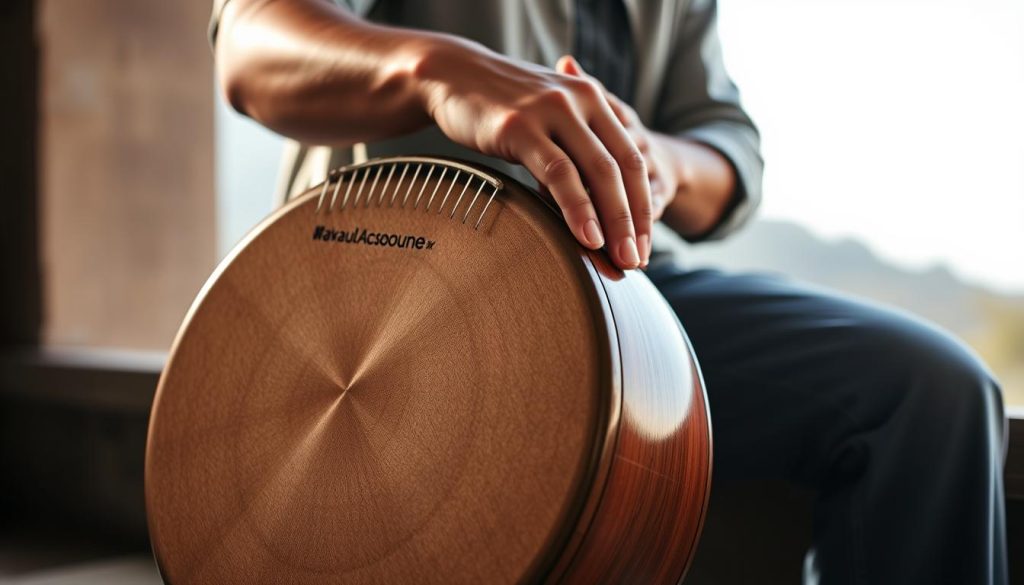
Tongue drum accessories: Essential or optional?
When buying a musical instrument, it helps to consider the accessories included with it. They may improve your playing experience, but they should not be the main reason for choosing a model.
Mallets, finger guards, note stickers, and carrying bags
The most common accessories are:
- Mallets: these beaters strike the tongues to produce rich, strong sounds.
- Finger guards: these let you play with your hands and provide a different tactile experience.
- Plectrums: used for playing, they can add a different quality to the sound.
- Note stickers: particularly useful for beginners, they make notes easy to identify visually.
- Sheet music booklet: a useful learning aid for playing your first melodies and understanding the instrument.
- Carrying bag: helps protect and transport your instrument.
Do not base your choice of tongue drum on whether accessories are included. Choose the model that best meets your needs, even if it comes with fewer extras than a less suitable model. You can buy accessories separately later.
A better-quality instrument with fewer accessories can be a better long-term investment. Mallets produce a stronger sound, while finger guards offer more direct contact with the instrument.
Accessories are a welcome bonus, but they should not determine which tongue drum you choose.
| Accessory | Purpose | Importance |
|---|---|---|
| Mallets | Produce rich sounds | High |
| Finger guards | Play with your hands | Medium |
| Plectrums | Vary the sound | Low |
| Stickers | Identify notes | High |
| Sheet music booklet | Learn to play | High |
| Carrying bag | Protect and transport the instrument | Medium |
For more advice on choosing an instrument suited to your level, read our article on musical instruments.
Tuning frequency: Understanding the difference between 432 Hz and 440 Hz
Tuning is central to understanding an instrument’s sound. The two most discussed reference frequencies are 440 Hz and 432 Hz. The former is the international reference pitch for A and corresponds to 440 cycles per second. At 432 Hz, that reference note is eight cycles per second lower.
Claimed effects of 432 Hz on the body and mind
Supporters of 432 Hz tuning say it has beneficial effects on the body and mind. They often mention deep relaxation and harmony with natural vibrations. Some also believe it improves overall well-being.
These claims need to be qualified. Scientific research has not established that this particular frequency benefits mental or physical health. Although the beliefs are widespread, they lack scientific support.
Compatibility with other musicians and musical styles
Compatibility with other musicians is another consideration. A reference pitch of 440 Hz is widely used in conventional music, making it easier to play in a group. A 432 Hz instrument, often associated with yoga and meditation, can be harder to play alongside instruments tuned differently.
For versatile use, 440 Hz is therefore the more practical choice. Tongue drums tuned to 432 Hz are less common and often more expensive. Although there are ways to alter their tuning, these are generally improvised adjustments rather than professional retuning.
The audible difference between the two tunings remains subtle. Your final choice will depend mainly on personal preference and how you intend to use the instrument.
| Frequency | Cycles per second | Main uses | Availability |
|---|---|---|---|
| 440 Hz | 440 | Conventional music | Common |
| 432 Hz | 432 | Relaxation, yoga, meditation | Less common |
Choosing among available brands and models: What should you know?
As tongue drums have grown in popularity, many brands have introduced a wide variety of models. The constantly changing selection can seem confusing to newcomers.
Established brands such as Himalaya Blessings, Zenko, Nataraj, Rammerdrum, and Rav Vast offer quality instruments, but these models are often considerably more expensive.
Buying a branded instrument can substantially increase your budget. It may cost two or three times as much as an equivalent generic model.
Some brands are simply applied to generic instruments. Unbranded versions can be much more affordable while still offering good value for money, especially for a first purchase.
Think carefully before spending more than €700 on a branded instrument that might end up in a closet. When reselling one, recovering more than half the purchase price is uncommon.
Beginners may be better off starting with an unbranded model. This lets them discover the instrument without a large initial expense. Whether to invest in a brand depends on personal preferences, budget, and expectations.
Choose between an established brand and a generic model according to how you intend to use the instrument and how much time you expect to spend playing it. As the saying goes,
“The best choice is the one that suits you.”
Tongue drum materials: Effects on durability and sound
Choosing a material can affect how an instrument performs and how long it lasts. Tongue drums are mainly made of metal, including steel, stainless steel, copper, and nitrided steel. Each material has characteristics that affect sound and durability.
Steel, stainless steel, copper, and specialized alloys
Standard steel is widely used because it is strong and affordable. Stainless steel offers better corrosion resistance, making it suitable for extended use. Copper is more expensive and produces warmer, richer tones, but it is less durable than the other metals.
Nitrided steel stands out for its resistance to impacts and corrosion. It is particularly suitable for outdoor use, especially in damp conditions. A steel-titanium alloy also offers a useful balance of tone and strength for demanding musicians.
How do you balance strength and sound quality?
It is important to keep the role of material in perspective. In general, the sound does not change dramatically from one material to another. For a first purchase, most standard steel models are already durable enough for ordinary indoor use.
If you plan to play outdoors, nitrided steel is worth considering if your budget allows. It withstands weather conditions better. Overall, material affects durability and lifespan more than sound quality, which remains relatively similar across metals.
Material need not be your first consideration. Focus instead on the number of tongues, the size, and the scale. Treat material as a secondary factor and choose an instrument that suits your intended use and budget.
| Material | Characteristics | Durability | Cost |
|---|---|---|---|
| Standard steel | Strong, affordable | Good | Economical |
| Stainless steel | Corrosion resistant | Excellent | Moderate |
| Copper | Warm tones | Less durable | High |
| Nitrided steel | Impact resistant | Very good | High |
| Steel-titanium | Balance of tone and strength | Good | High |
Scales and keys: Major, minor, and other variations
Musical scales are central to an instrument’s sound. They are broadly divided into major and minor scales. Major scales tend to sound cheerful and warm, while minor scales create a more melancholic, introspective atmosphere.
Pentatonic scales have five distinct notes, sometimes repeated across several octaves. They suit intuitive playing and musical meditation. Diatonic scales have seven notes (C, D, E, F, G, A, B) and offer beginners a useful range for playing familiar melodies.
Chromatic scales have 12 distinct notes, including altered notes such as F-sharp, but they remain rare on these instruments. More unusual scales such as Akebono (Japanese), Hijaz (Mediterranean), Celtic, or Amara often appeal to experienced players familiar with their distinctive sounds.
Beginners are advised to choose an instrument in C, D, or F major. C major is particularly approachable because of its simplicity and warm sound. Some scale names, such as “Happy,” “Zen,” and “Melancholia,” are primarily marketing terms intended to encourage a purchase.
There are also multi-scale tongue drums that use magnets placed on the tongues to change the scale. These models generally cost between €400 and €500. At that price, buying several instruments with different tunings may make more sense.
Choose a scale that suits your playing level and musical goals. C major remains a reliable option for most musicians.
How should you choose a tongue drum for your level and intended use?
Choosing an instrument that suits your level and goals will help you enjoy playing it. Every musician has different expectations worth considering.
An instrument for sheet music or intuitive playing
To play sheet music for familiar pieces, choose an instrument with plenty of notes, ideally 15 or more. This allows you to play a wider variety of more complex music.
For intuitive playing, the number of notes matters less. Many musicians enjoy following the soothing sounds of an instrument with only 6 or 8 notes.
Meditation, relaxation, and stage performance
For meditation and relaxation, a larger instrument offers deep sounds and long resonance. Such instruments are often tuned to 432 Hz.
For stage performances, a wide musical range and strong sound projection help the instrument reach and engage the audience.
The tongue drum is easy to begin playing. Even people without musical training can enjoy it. Unlike instruments such as the violin or piano, which require hundreds of hours of practice, a tongue drum can provide an immediately enjoyable musical experience.
Beginners should decide how they plan to use the instrument before buying one. This will help them choose a suitable model. Remember that your expectations may change, so consider an instrument that leaves room for progress.
Base your final choice on your current level, musical goals, and primary intended use.
Budget: What should you expect to pay for a suitable tongue drum?
Budget matters when buying an instrument, but first decide what you expect from it. Here is an overview of the prices of different models.
From entry-level to premium models
Small tongue drums start at around €50. They often have only 6 or 8 notes, which may suit beginners or anyone exploring simple melodies.
Prices gradually rise to about €200 for larger models with more tongues and more musical possibilities. These instruments suit players who want to tackle more complex pieces.
Models from established brands can cost more than €1,000. Careful workmanship and exceptional sound quality are often cited to justify the price.
How to make the most of your budget
Do not let price alone determine your choice. First define your needs using the factors covered in this guide. If your budget is limited, it may be better to save for longer than to buy an instrument that does not suit you.
For example, if you want to play songs such as Alan Walker’s “Faded,” a small 6- or 8-note model will not have enough notes, regardless of its price. Consider both the number of tongues and the instrument’s size in relation to your needs.
An unbranded 10-tongue model may cost less than €100, while a 15-note instrument costs around €200. A tongue drum is a long-term purchase, so aim for good value, especially if it is your first.
Choose a tongue drum according to your actual needs, rather than price alone. A suitable instrument can provide lasting musical enjoyment.
| Model type | Approximate price | Number of notes | Recommended use |
|---|---|---|---|
| Entry-level | From €50 | 6 to 8 notes | Beginners, simple melodies |
| Mid-range | Around €200 | 10 to 15 notes | Musicians who want to play varied pieces |
| Premium | Over €1,000 | Varies | Advanced musicians, professional performances |
For more advice on choosing your instrument, read our detailed guide.
Choosing for children, beginners, and advanced musicians
Choose an instrument that matches the player’s abilities, whether they are a child or a beginner. For children, no more than 11 notes is recommended. This makes the instrument easier to handle and learning more enjoyable.
For preschool and elementary school children, an instrument 15 to 20 centimeters in diameter is ideal. Even young children can handle one comfortably. Musical activities can support children’s development and creativity.
For children, a model in C or F major with 8 to 11 notes is recommended. These keys are often chosen for beginners discovering music.
Adult beginners can choose a tongue drum with up to 15 notes. This provides room to improve without being too complicated at first. Instruments with more than 15 tongues are better suited to experienced musicians familiar with melodic percussion.
A beginner may enjoy a 6-note tongue drum more than an 18-note model they cannot yet play confidently. Teachers also appreciate the instrument as a creative musical activity beyond the traditional recorder.
When choosing a tongue count, consider both the musician’s current level and their future progress. Different players have different needs, so a suitable model makes learning more enjoyable.
| Player | Recommended model | Number of notes | Size |
|---|---|---|---|
| Children | Simple model | 8 to 11 notes | 15 to 20 cm |
| Adult beginners | Intermediate model | Up to 15 notes | Varies |
| Experienced musicians | Advanced model | More than 15 notes | Varies |
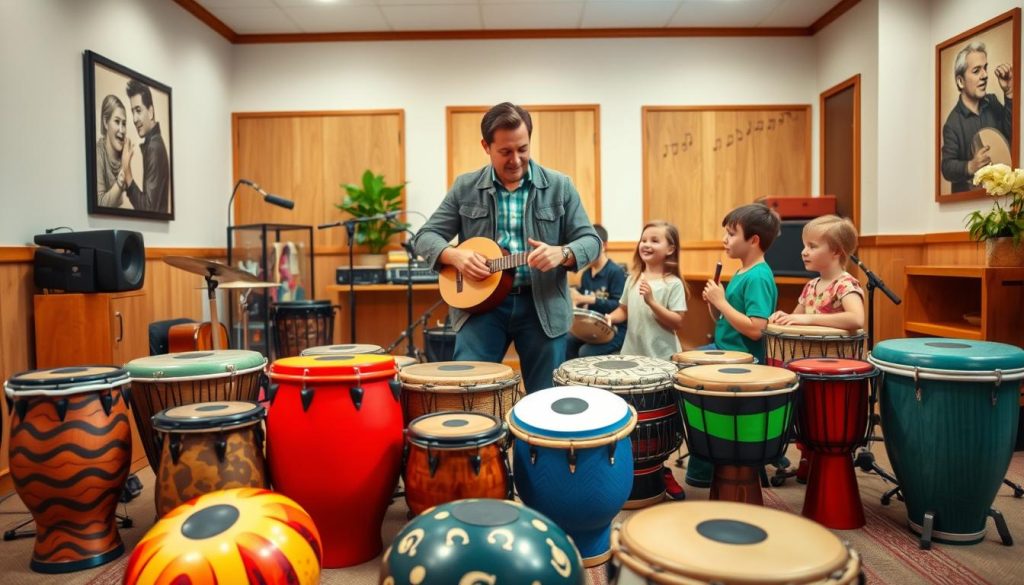
Differences between tongue drums, handpans, tank drums, and similar instruments
Although these musical instruments share some features, their construction and sound distinguish them.
Construction and sound
Construction is a key difference. The top shell of a tongue drum is cut to form distinctive tongues and grooves. A handpan is hammered into shape and has no cutouts. If you see grooves cut into the surface, it is a tongue drum. A Hang Drum has indented areas instead.
A handpan is generally larger in diameter than a tongue drum, affecting the depth and resonance of its sound. A Swiss couple created the handpan in 2001, and their innovation strongly influenced Dennis Havlena when he designed the tongue drum in 2007.
Different uses and musical experiences
The tongue drum is also called a tank drum, hank drum, steel tongue drum, tongue percussion drum, or zen drum. “Tongue drum” and “tank drum” refer to the same instrument; usage varies by region and maker.
The handpan is often regarded as a more meditative instrument, producing enveloping sounds. A tongue drum can offer a wider variety of notes, making familiar pieces easier to play.
Tongue drums are also generally more affordable than handpans, giving beginners an accessible introduction to melodic percussion. Although the instruments are related, they offer different musical experiences. Choose according to the sound you prefer and how you intend to play.
| Instrument | Construction method | Sound characteristics | Uses |
|---|---|---|---|
| Tongue Drum | Cut metal | Variety of notes | Accessible playing, familiar pieces |
| Handpan | Hammered metal | Enveloping sounds | Meditation, calm atmosphere |
| Tank Drum | Cut metal | Same as a tongue drum | Varied uses |
Practical tips for starting out and enjoying your 432 Hz tongue drum
Learning an instrument can seem daunting, but the tongue drum is accessible to everyone. Its intuitive approach lets people express themselves musically without prior knowledge. These tips will help you get started and enjoy playing.
Playing techniques and learning step by step
First, get to know the basic techniques:
- Use mallets: strike the tongues with these beaters to produce rich sounds.
- Play with your fingers: this gives you more direct contact with the instrument.
- Create sound effects: place your hand in front of the resonating chamber’s opening, then move it away to change the sound.
Begin by playing intuitively to become familiar with the sounds and vibrations. You can then gradually start playing simple written melodies, developing your musical ear and technique.
Caring for the instrument as you progress
Taking care of your instrument helps preserve its sound. Follow these care tips:
- Protect the instrument from moisture: store it somewhere cool and dry, away from direct sunlight.
- Use a case: it protects the instrument from dust and impacts during transport.
- Clean it regularly: remove dirt with a soft, dry cloth and avoid harsh cleaning products.
Your expectations and playing ability will change over time. After a few months, you may want a more advanced model. Explore different scales and tunings to broaden your musical experience.
Regular practice can provide an enjoyable way to unwind and develop coordination. Claims that a tongue drum specifically lowers blood pressure, reduces anxiety, improves sleep, or changes brain connections require stronger evidence.
A 432 Hz tongue drum can be a rewarding companion for relaxation and musical exploration as your skills develop.

Conclusion: Choose a 432 Hz tongue drum you can enjoy as you progress
Choosing a musical instrument calls for clear criteria. Although the tongue drum is often played intuitively, it is worth considering these factors before buying one:
- Number of tongues: more notes give you more musical possibilities.
- Size: choose a model that suits your comfort and intended use.
- Accessories: consider which extras will improve your experience.
- Tuning frequency: think about whether you want to meditate or play with other musicians.
- Brand and material: these factors can affect durability and sound.
- Scale and budget: set a budget with your future goals in mind.
Choosing a model that slightly exceeds your current needs gives you room to improve. For those looking for a quality instrument, the Instruments du Monde shop offers a 15-note tongue drum with appealing tones.
Think of this instrument as a long-term investment in relaxation and musical development. If you enjoy its sound, a model tuned to 432 Hz may suit meditation and yoga sessions.
Share what you learn with other enthusiasts to help them choose. The pleasure of playing soothing melodies on an instrument suited to your level is invaluable, and every musician can find a suitable model.