

The tongue drum is an intuitive melodic instrument, perfect for people with no musical training. Its accessibility makes it an ideal choice for beginners. In this article, we offer a complete method for learning to play familiar melodies using simplified sheet music.
You will learn how to read numbers, rhythmic markings and rests, then apply what you have learned directly to your instrument. This guide presents ten essential tunes, advice on adapting them to different models and a progressive practice routine.
Playing simply does not mean playing without expression. On the contrary, it lets you quickly develop accuracy, a sense of rhythm and coordination. Before long, you will move from theory to practice without needing to read traditional music notation.
The method uses numbered notation to make learning enjoyable from the first session. This article is for everyone: beginners, musicians returning after a break and anyone looking for a ready-to-play repertoire. The tongue drum can also offer therapeutic benefits, such as stress reduction and creative expression.
Introduction to the tongue drum and the value of easy sheet music
The tongue drum is a melodic percussion instrument whose simplicity and accessibility make it fascinating. It has metal strips called tongues, each of which produces a distinct note when struck. Even novice musicians can use it to create harmonious melodies.
What is a tongue drum?
This instrument is tuned to a diatonic or pentatonic scale. This means the notes sound good together, even when played at random. Tongue drum models have between 8 and 15 notes. Beginners are advised to start with a simple 8- or 11-note model in C major.
Why learn with simple sheet music?
Simple sheet music acts as a melodic map. It provides guidance without imposing rigid rules and encourages creative expression. By playing familiar melodies from the first session, beginners feel less frustrated and enjoy themselves more.
- Sheet music helps develop a sense of rhythm.
- It improves hand-eye coordination.
- Numbered notation (C = 1, D = 2) makes learning easier.
- Visual aids make melodies easier to remember.
Benefits for music beginners
For beginners, simplified sheet music provides a quick way to build musical skills. It helps them master the notes and understand rhythm without tackling the complexities of advanced technique. According to Emmanuel Bigand of the CNRS, reading music stimulates visual memory and improves spatial awareness.
In short, simple sheet music is a stepping stone to improvisation and personal expression on the tongue drum. It lets musicians focus on the pleasure of playing while developing their skills.
Understanding your tongue drum: notes, tongues and layout
Each tongue on your instrument vibrates when struck and produces a distinct note. This is essential to creating harmonious melodies. The arrangement of the tongues also affects how easily you can move between notes and read sheet music.
Tongue drum models on the market differ in their number of notes. You can find instruments with 8, 9, 11 or even 15 notes. Eight-note models are often recommended for beginners because they make learning simpler.
How the tongues correspond to notes
Each tongue is marked with a number corresponding to a note. For example, on a drum in C major, the tonic, or “1,” is C. This simplified notation helps you memorize where the notes are before reading a piece of sheet music.
Different models and common scales
One common scale is the pentatonic scale, which has 5 notes per octave. It is ideal for beginners because it helps avoid clashing notes. Other scales, such as the major scale, sound bright and cheerful, while minor scales create a more introspective mood.
Distinctive scales such as Akebono and Pygmy add unique meditative sounds. Each model has a circular or linear layout that helps you find the notes.
Finding the notes on your instrument
To play well, you need to know where the notes are. Use the numbers engraved on the tongues to identify each note. You can also add note stickers to make learning easier. Always check that the sheet music suits your instrument: a piece may sound wrong if notes are missing or the required octave is unavailable.
In short, understanding your tongue drum and its notes is essential to making progress. It will help you choose suitable pieces and avoid common mistakes. To learn more, read this article on reading sheet music.
Why use easy tongue drum sheet music: a practical guide for beginners
Using simplified sheet music for your instrument can transform your musical experience. Rather than rigid rules, these pieces provide melodic maps that make rhythms and tunes easier to learn. They can be a stepping stone to creative improvisation.
By following the sheet music, you will discover how rhythm and dynamics can turn a flat rendition of a song into a lively performance. This helps you understand melodic structure and how simple notes combine to create expressive melodies.

Reading these pieces regularly also strengthens your visual memory. Your eyes recognize the sequence of numbers and anticipate the movements needed to strike the tongues. This improves hand-eye coordination, an essential skill for progressing quickly on the instrument.
Written music helps you play sequences consistently, hesitate less and make noticeably fewer note errors. Practicing with a metronome while following sheet music can also help you develop rhythmic accuracy more quickly.
Sheet music guides you through different note combinations and helps you explore your instrument’s potential. Every tongue has its own tone and overtones; the music helps you discover the instrument’s full acoustic richness.
In conclusion, simplified sheet music can reduce frustration, speed up progress and build confidence. It prepares you to improvise freely and deepen your passion for music.
Simplified numbered notation for tongue drum: reading numbers and symbols
Numbered notation, often called Jianpu, makes notes easier for novice musicians to learn. It represents the seven notes of a major scale with the numbers 1 through 7. Thus C is written as 1, D as 2, and so on through B, written as 7.
The numbered system from C = 1 to B = 7 explained
To begin, find “1” (C) on your instrument. It is usually the largest tongue or one with a clearly visible marking. On many models, the numbers are engraved directly on the tongues.
Rhythmic symbols: dashes, dots, rests and chords
The numbers are accompanied by rhythmic symbols. For example, a dash (-) extends the length of a note, while a vertical bar (|) separates measures. Dots placed after a note also extend its duration. A rest is shown by “0” or a blank space, helping you keep time.
Parentheses group notes that should be played together. For example, (13) means playing C and E simultaneously. These symbols make melodies more intuitive to read.
Octaves and other essential markings
The octave system is also important. A dot above a number indicates a higher octave, while a dot below indicates a lower one. This makes it possible to represent a wider range on your compact instrument.
Accents (>) mark emphasized beats and bring the melody to life. Alongside numbered notation, there is another useful option: letter notation (C-D-E), especially for people coming from piano or guitar.
To show how simple the system is, consider the melody “Twinkle, Twinkle, Little Star”:
| Measure | Notes |
|---|---|
| 1 | 1 1 |
| 2 | 5 5 |
| 3 | 6 6 5 – |
| 4 | 4 4 3 3 |
| 5 | 2 2 1 – |
It is best to choose just one notation system at first. Later, you can gradually learn to switch between numbers and letters to become more flexible.
Methods and tips for getting started with your instrument
Playing the tongue drum may seem intimidating at first, but the right methods can help any musician progress quickly. Start with a model suited to your level. An 8- or 11-note drum in C major is recommended because it makes the notes easier to find and learn.
Choosing the right model and scale
For children under 8, a model measuring 15 or 20 cm is ideal. For older children and adults, a 25 to 30 cm drum can make learning easier. Choosing a suitable instrument supports a positive learning experience.
Slow down and practice slowly to improve accuracy
There is no rush: play each note in turn, even if the tempo seems extremely slow. Accuracy and a clear sound matter more than speed. Try humming the melody while tracing the numbers with your finger before picking up the mallets. This will help you form a mental picture of the song.
Use auditory and visual memory together
Hear the melody in your head as you read the numbers on the sheet music. Picture the corresponding tongues on your instrument. This approach strengthens your memory and improves your musical understanding.
Accept mistakes and keep playing enjoyable
Remember that the tongue drum’s harmonious tuning softens the effect of mistakes. If you miss a note, keep going. The aim is to maintain the musical flow rather than achieve perfection. Accept imperfection as part of learning and, above all, enjoy playing.
Short, regular sessions instead of long, intensive ones can also help you stay motivated. Alternate between learning new pieces and revisiting ones you already know to maintain your enthusiasm.
| Tip | Details |
|---|---|
| Suitable model | Choose an 8- or 11-note drum to start with. |
| Slow practice | Play each note slowly to improve accuracy. |
| Auditory memory | Listen to and visualize the notes as you play. |
| Accept mistakes | Keep playing even if you miss a note. |
| Short sessions | Practice regularly in short sessions to avoid fatigue. |
Preparing your equipment: mallets, stickers and useful accessories
Before you start playing, prepare your equipment. This includes choosing mallets, using stickers to identify the notes and getting other useful accessories ready. These items make learning easier and improve your musical experience.
Mallets or fingers: which should you choose for your level?
Mallets are often recommended for beginners. They produce a clear, strong, pure sound, ideal for your first steps on the instrument. Playing with your fingers offers more subtlety and resonance but requires a particular striking technique that takes practice.
Starting with mallets will help you produce a good sound quickly. Once you feel comfortable, you can switch to your fingers to enrich your playing and bring out more subtle dynamics.
Note stickers: how they help and when to remove them
Stickers for identifying notes are particularly useful at first. They help you visually connect each note to its number and tongue. To apply them, follow the manufacturer’s instructions, check your instrument’s orientation and test each note before your first session.
It is a good idea to remove the stickers gradually. This strengthens your visual memory and helps you play independently. As you get used to playing without visual markers, you will understand the notes and their layout better.
Other recommended accessories (metronome, stand and case)
Besides mallets and stickers, several accessories can improve your practice. A metronome is essential for working on tempo and rhythmic accuracy. A stable stand helps position your instrument, while a case is useful for carrying and protecting your instrument.
Finally, using a contact microphone or smartphone to record yourself can help you assess your progress. You can identify areas to improve and track your musical development.
For effective practice, aim for short 20-minute sessions at a steady tempo and record yourself. This approach is more beneficial than long, unstructured sessions.

10 easy tongue drum pieces: essential songs for beginners
Discovering simple melodies is essential to progressing with your instrument. Here are ten suitable pieces that will help you build your skills while having fun.
Happy Birthday: a simple sequence and rhythm tips
“Happy Birthday” is perfect for getting started. Its simple 1-1-2-1-4-3 sequence can be played at around 80 BPM. Use soft mallets for a gentle sound. Play each phrase smoothly for a harmonious result.
Frère Jacques: left- and right-hand coordination
“Frère Jacques” lets you work on coordination. The repeated pattern 1-2-3-1 / 1-2-3-1 / 3-4-5 / 3-4-5 is ideal for making alternation between your left and right hands automatic. This will help you play more fluidly.
Au clair de la lune and other popular melodies
“Au clair de la lune” uses the pattern 1-1-1-2 / 3-3-2-1. Practice it at around 70 BPM, paying attention to the longer notes. Listen to each note resonate before moving to the next.
Another piece, “Twinkle, Twinkle, Little Star,” follows the sequence 1 1 5 5 | 6 6 5 – | 4 4 3 3 | 2 2 1 –. It is ideal for practicing one phrase at a time and absorbing the melody.
“Amazing Grace” will help you focus on a gentle touch and well-timed rests. Observe the length of the notes to make your instrument sing. For a creative exercise, try a “Pentatonic Lullaby” by improvising around a two- or three-note pattern.
To play a “Folk Tune,” repeat the main phrase for a few minutes. This makes it easier to memorize and play steadily. For a more relaxing mood, try a “Meditative Melody” at a slow tempo, listening to how the tone changes depending on where you strike the tongue.
Finally, you can create a “Mini Rhythm Routine” with a four-beat pattern, alternating your left and right hands. This will build your stamina and accuracy.
To make the pieces your own, add pauses, accents or chords. This will enrich your playing without making the music harder to read.
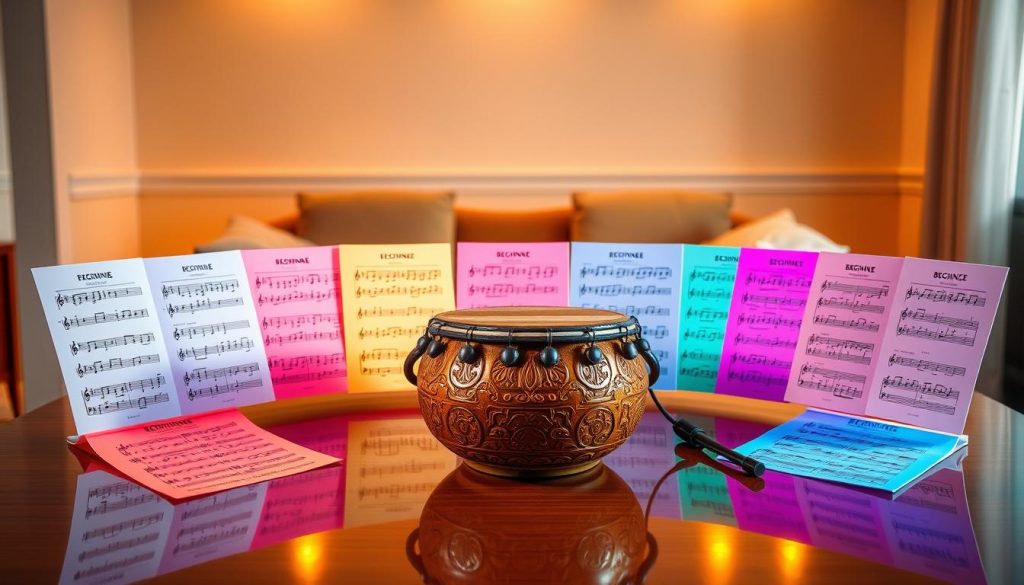
Where to find free sheet music and resources for improving
Exploring online resources can make learning much easier. Many specialist sites offer sheet music and guides for aspiring musicians. These resources can help you progress quickly on your instrument.
Specialist websites and downloadable PDFs
Platforms such as TongueDrumTunes.com offer pieces organized by difficulty. You can find downloadable PDFs for every level. DrumSheetMusic.org is also useful for practicing complex rhythms.
Instruments du Monde offers free sheet music suited to beginners. Reputable manufacturers also often include a songbook with the instrument to help you get started.
Online video tutorials and practical advice
Tutorials on YouTube are an excellent resource. Searching for “tongue drum sheet music” or “kalimba sheet music” will bring up demonstrations of hand placement and playing techniques. These videos can help you correct your movements quickly.
Sites such as Pinterest and various community forums also offer thousands of visual scores. These resources are easy to follow and ideal for learning popular melodies.
English-speaking communities and exchanges between players
Joining English-speaking communities is a great way to exchange files and advice. You can share your experiences and get feedback on your playing. Some music schools also run tongue drum workshops where you can meet other enthusiasts.
Finally, check the notation key, key signature, scale and suggested tempo before downloading or using sheet music you find online. This will help you choose melodies suited to your instrument.
| Resources | Description |
|---|---|
| TongueDrumTunes.com | Pieces organized by difficulty and downloadable PDFs. |
| DrumSheetMusic.org | Useful for practicing complex rhythms. |
| Instruments du Monde | Free sheet music suited to beginners. |
| YouTube | Video tutorials on hand placement and playing techniques. |
| Pinterest and forums | Access to thousands of visual scores. |
| ZenaPan songbook | Contains 13 melodies with performance tips. |
| Music workshops | Opportunities to exchange ideas and learn with other players. |
Adapting sheet music to your tongue drum: simplifying and transposing
To play comfortably, adapt sheet music to your instrument. This lets you preserve a piece’s musical identity while making it more accessible.
Identify the notes available on your instrument
Start by identifying the main melodic line, which carries the tune. It is often helpful to remove fast ornaments that make a piece harder to play. Focus on a steady rhythm to make your playing flow more smoothly.
If you encounter a difficult chord, consider replacing it with an arpeggio by playing its notes one after another. This preserves the essence of the melody without making the passage overwhelming.
Simplify a melody without losing its musical structure
Simplification is essential. Replace complicated figures with the notes the melody needs. Always keep its structure in mind. This will help you play coherently and pleasantly.
Transpose to match your scale
Transposition is a key technique. It means shifting the entire melody to match the notes available on your instrument. If a note is missing, it is often better to move the phrase into a playable range.
With an 8- or 9-note model, you will need to simplify some melodies. A 15-note instrument can reproduce the original melodies more faithfully and offers more octaves.
Structure your arrangements for greater creativity
To structure your arrangements, use an A-A-B-A pattern. It consists of short repetitions, followed by a bridge and then a return to the main melody. This structure makes your versions more coherent and easier to remember.
Remember to leave short rests so the notes can ring out. This lets you enjoy your instrument’s natural resonance. Vary your performances with accents, pauses or sustained notes while preserving the original melodic line.
For more practical examples of adaptation, read the sheet music guide from Instruments du Monde, which shows how to preserve a melody while respecting your instrument’s key.
How to practice effectively without losing motivation
Regular practice is essential to progressing with your instrument. To stay motivated, organize your sessions. Here are some practical tips for maintaining your enthusiasm and improving your skills.
Plan short, regular sessions
A daily 20-minute routine can be very effective. You may notice progress in just three weeks. Structure each session as follows:
- 2 to 3 minutes of warm-up with breathing exercises and slow strikes.
- 10 minutes of slowly reading one phrase with a metronome.
- 5 minutes of playing the whole piece.
- 2 minutes to review your progress and note what to work on.
Use a metronome to improve rhythmic accuracy
A metronome is a valuable tool for developing rhythmic accuracy. Start at 60 to 70 BPM and play three successful repetitions before increasing the tempo in 5 BPM steps. This will help steady your playing.
Record yourself to improve and correct mistakes
Record yourself regularly with a smartphone or contact microphone. This lets you listen to your playing more objectively and identify mistakes to correct. You can also track your progress over time.
Finger exercises and alternating between mallets and fingers
Practice alternating your left and right hands on a short pattern. This will build stamina and consistency. Switch between mallets and fingers to vary the tone and protect your skin. Work on your rebound technique: strike without holding the mallet or finger against the tongue, then let it lift away for a clear sound.
In short, regular, organized sessions support effective learning. Adjust your posture and take regular breaks to avoid pain and fatigue.
| Tip | Details |
|---|---|
| Session length | Practice for 20 minutes daily to see progress. |
| Session structure | Warm-up, reading, playing through and review. |
| Using a metronome | Start at 60 to 70 BPM and increase gradually. |
| Recording | Analyze your playing to identify mistakes. |
| Finger exercises | Alternate left and right hands to build stamina. |
Conclusion: your musical journey with the tongue drum starts here
Your musical adventure begins with an instrument that can bring a unique sense of inner peace. The tongue drum is much more than an instrument; it opens the door to creative expression. The sheet music you explore helps you step through that door by making music theory accessible to everyone.
Use these pieces of sheet music as guides. Learn the basics, then make room for your creativity. Enjoy the therapeutic benefits of this instrument, such as reduced stress and improved well-being.
Choose two melodies from this article, practice them with a metronome and record yourself to track your progress. Adapt the sheet music to your style and try your own variations. Reliable resources and an active community of English-speaking players can help you continue learning.
Mastering the notes and sheet music gives you immense musical freedom. Pick up your mallets, find your “1” and start your musical journey today!