

The steel tongue drum is a fascinating musical instrument created by Dennis Havlena in 2007. Made of steel, this percussion instrument is known for its soothing, melodic sounds, which create a relaxing atmosphere.
Accessible to everyone, from beginners to experienced musicians, it invites musical exploration. Its growing popularity around the world is linked to its ability to enrich moments of meditation and relaxation.
In this article, we will explore this unique instrument. You will discover its history, how it works and practical advice for getting started. Get ready for an intuitive, universal sound experience that will captivate you.
What is a steel tongue drum? Definition and technical features
This beautiful percussion instrument belongs to the idiophone family. Its sound is produced directly by the material from which it is made. Made mainly of steel, it offers rich, lasting resonance. Premium models use stainless steel alloys to prevent rust and ensure a clear sound.
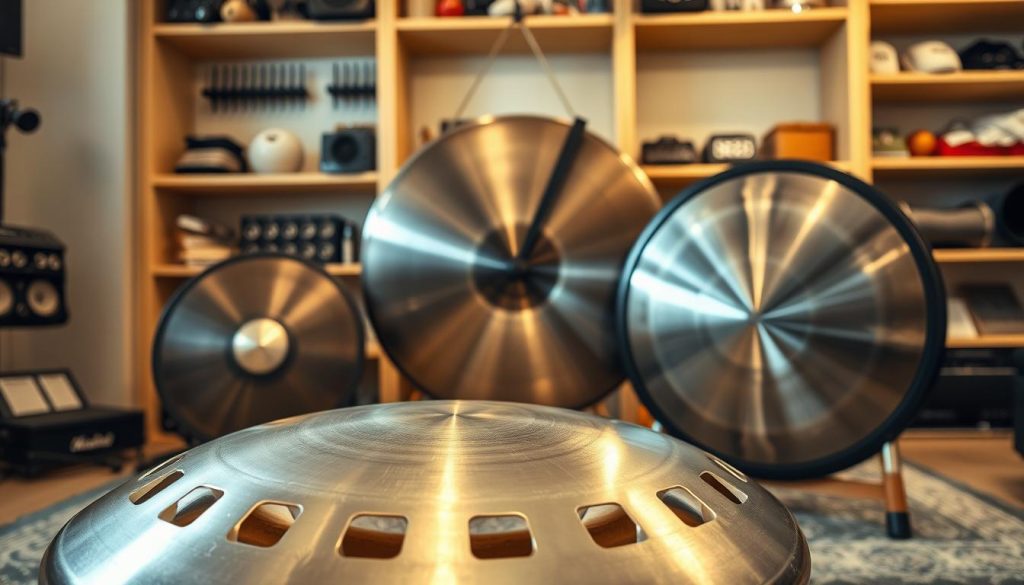
The instrument is circular and slightly flattened, resembling a flying saucer. Several tabs, called “tongues,” are cut into its upper surface. These cuts, often arranged in floral or geometric patterns, are essential to producing its notes.
The tongues are laser-cut for precision or shaped by hand for a distinctive handcrafted character. A circular opening underneath the instrument helps amplify the vibrations produced by the tongues.
Structure and materials
The materials used to make a tongue drum are essential to its sound quality. Steel and metal alloys produce rich resonance. The tongue-shaped cuts are more than decorative; they also determine the notes the instrument produces.
Number of tongues (notes) and shapes
The number of tongues generally ranges from 6 to 14, directly affecting the melodic possibilities. Each tongue is carefully tuned to produce a specific note. Designs range from compact round models to more unusual shapes, allowing musicians to choose what suits them best.
Tuning and musical scales
Each tongue is precisely tuned to produce a particular note. Instruments can be tuned to different musical scales, including pentatonic, diatonic and chromatic scales. Distinctive scales such as Akebono and Hijaz are also available, offering a variety of sounds and musical expressions.
Thanks to its structure and materials, this captivating instrument offers a unique sound experience that attracts many musicians. To learn more, read our complete article on everything you need to know about the tongue drum.
Origins and history of the steel tongue drum
The origins of this captivating instrument draw on centuries-old musical traditions from around the world. The tongue drum has a rich and varied history shaped by several ancestral instruments.
Predecessors: slit drums and teponaztlis
Slit drums, found on several continents, are direct predecessors of the tongue drum. These wooden instruments, at least 500 years old, have been used in many cultures.
- Teponaztlis, used by Aztec and Maya civilizations in South America, are emblematic examples of this tradition.
- These instruments produce sound through their slits, a principle that became fundamental to the tongue drum’s development.
Major inventions: Whale Drum, Hang Drum and Tambiro
Several innovations have shaped this instrument’s history. In 1990, Jim Doble created the Whale Drum from discarded gas cylinders. Its whale-song-like sounds opened the way to new sonic exploration.
In 2001, the Hang Drum, designed by Felix Rohner and Sabina Schärer, profoundly influenced modern instrument design. Its distinctive shape and note layout inspired many musicians.
In 2005, the Tambiro, introduced by professional musician Fellé Vega, also contributed to the tongue drum’s development, although it was never marketed commercially.
Dennis Havlena’s invention of the steel tongue drum
In 2007, Dennis Havlena made a breakthrough by creating the first steel tongue drum. Drawing on earlier innovations, he cut tongue shapes into a 13 kg propane cylinder. This approach brought together advantages of the handpan and the Tambiro.
Havlena also introduced neodymium magnets to tune each note precisely, paving the way for instruments with multiple scales. Since his invention, production has become industrialized, with more precise processes replacing handcrafted methods.
The instrument’s success has led to a variety of models, including electroacoustic versions that further enrich the musical experience.
To learn more about its development, read our complete article on the history of the tongue drum.

How the steel tongue drum works: acoustic principles
The acoustics of this instrument rest on fascinating principles. When a musician strikes a tongue, it vibrates. Those vibrations travel through the hollow body, which acts as a resonating chamber. The sound level can reach approximately 70 to 80 decibels.
Tongue vibrations and sound propagation
Each strike on a metal tongue creates a vibration at a particular frequency, determined by its size and shape. Sound waves travel through the hollow body, which acts as a natural resonating chamber. This amplifies the sound and enriches the musical experience.
The role of the resonating chamber
The resonating chamber is essential to amplifying the sound. The sound hole, often underneath the instrument, can also create effects. By covering or uncovering it, the musician can change the sound produced.
How tongue size and instrument diameter affect sound
The surface area of each tongue directly affects the pitch of its note. Large tongues produce lower sounds, while small ones produce higher sounds. The instrument’s diameter also affects its tone. A larger instrument produces deeper vibrations and longer resonance.
- Each tongue is carefully measured to ensure accurate tuning.
- Secondary notes produced by natural resonance enrich the sound.
- Precise tongue cutting is essential to sound quality.
- A small 20 to 25 cm model supports fast playing, while a large model of 40 cm or more produces deeper sounds.
Differences between the steel tongue drum, Hang and handpan
These instruments differ in their design and sound. Let us compare the tongue drum, Hang and handpan to understand the characteristics of each.
Design and construction
The Hang, invented in Switzerland in 2000 by Felix Rohner and Sabina Schärer, made musical history. Its name means “hand” in Bernese German. Handpan is a general term for instruments similar to the Hang, developed by various makers after it became popular.
The tongue drum stands out for its visible, cut-out tongues, which produce its notes. The handpan instead has hammered indentations on a domed surface, giving it a distinctive appearance.
- A tongue drum’s tongues are cut into the steel by laser or by hand.
- A handpan is hammered and shaped by hand from two welded metal shells.
- The tongue drum has visible slots, while the handpan has indentations.
Sound and playability
These instruments sound quite different. The tongue drum produces more percussive and varied sounds, while the Hang and handpan have more resonant, ethereal and harmonious tones.
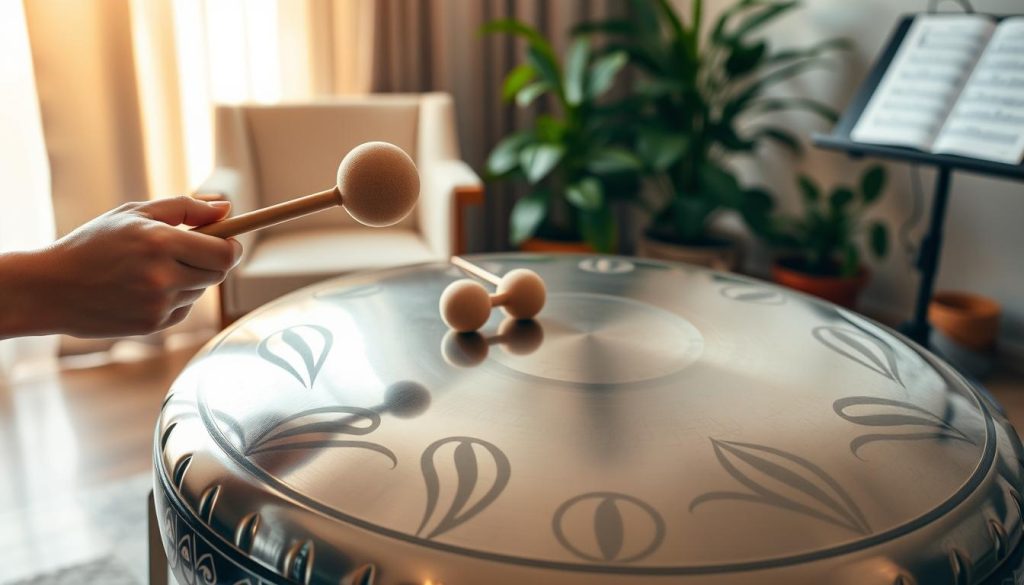
The tongue drum can be played with the fingers or mallets, offering considerable flexibility. The Hang and handpan are played exclusively with the hands and require a gentle touch.
Uses and musical approach
The instruments also have different uses. Versatile tongue drums suit both meditation and musical performances. Handpans are often favored for intimate acoustic concerts.
The tongue drum is accessible to everyone and requires no prior musical knowledge. The handpan takes more practice to master its nuances.
The two instruments complement each other. Many musicians play both to enrich their musical experience.
Playing techniques: hands or mallets?
Your playing technique can transform the musical experience. There are two main approaches to the tongue drum: playing with your hands or using mallets. Each has particular advantages.
Playing with your hands: control and nuance
Playing with your hands gives you direct control over subtle variations in sound. This method is ideal for producing warm, natural tones. The striking technique takes a little practice, however: too much pressure can dampen the sound.
Using mallets: clear sound and stronger resonance
Mallets produce a clearer sound and stronger resonance. They are often recommended for beginners because they make accurate playing easier. Mallets are generally covered in rubber or felt, protecting the tongues while amplifying the sound.
Comparing the advantages and disadvantages
- Playing with your hands: allows greater expression and direct contact with the instrument.
- Using mallets: promotes clarity and volume, making them suitable for precise performances.
- You can combine both techniques to enrich your musical experience.
- A glissando can be played with the fingers or mallets, adding a melodic dimension.
- Beginners are advised to start with mallets to become familiar with the instrument before exploring finger playing.
The tongue drum can be played solo or in an ensemble. Each technique suits a different setting: meditation, solo performance or accompaniment of other instruments.
The sounds and distinctive scales of the steel tongue drum
A percussion instrument’s scale shapes its sonic identity. On a tongue drum, each combination of notes creates a musical character and mood. Every scale offers its own range of melodies and emotions.
Major, minor and special scales
Major scales produce lively, upbeat melodies suited to cheerful pieces. Minor scales create melancholy, introspective tunes ideal for meditation. Special scales include Akebono, which adds a gentle Japanese character, and Hijaz, which evokes captivating Middle Eastern sounds. Pygmy and Amara scales also add distinctive colors to the musical experience.
Different tuning frequencies
Most instruments are tuned to 440 Hz, the Western standard. Some models, however, are tuned to 432 Hz, a frequency reputed to have healing properties and a connection with natural energy. Others are tuned to 528 Hz, often called the “love frequency” and used in sound therapy for its reputed restorative qualities.
Why choosing a key matters to the musical experience
Choosing the right key is essential before buying a tongue drum. Changing scales after purchase can be difficult. Neodymium magnets can make small tuning adjustments, but using them requires some expertise. Beat Root’s Multi-Scale model suits people seeking more flexibility: it makes switching between scales easy.
Your chosen scale shapes the entire musical experience. Whether for meditation, relaxation or performance, every note helps create a particular atmosphere. To explore the options, visit the Beat Root website.

Benefits and uses: meditation, relaxation and musical performance
Playing music, including this instrument, can support well-being and calm. Studies show that playing an instrument can reduce blood pressure, stress and anxiety. It can also improve sleep quality and coordination.
The instrument’s gentle, soothing sounds reinforce these benefits. It is easy to pick up and requires no ability to read music, so anyone can enjoy it quickly.
- Stress reduction: soothing melodies encourage relaxation.
- Better sleep: repeated sounds act like a natural lullaby.
- Emotional balance: in sound therapy, it helps harmonize energies and balance the chakras.
- Meditation support: it creates an atmosphere suited to introspection.
- Yoga practice: hypnotic melodies help you focus on your breathing.
- Concert use: it blends well with instruments such as guitar and piano.
- Creative stimulation: accessible to everyone, it encourages personal expression.
The instrument’s vibrations promote inner calm by acting directly on the body and nervous system. It therefore has a place in meditation sessions, yoga and musical performances.
It is a valuable tool for musicians and for anyone who wants to enrich their musical experience while caring for their well-being.
How do you choose a steel tongue drum? Essential criteria
Choosing a percussion instrument can seem complicated, but a few essential criteria will help you find a model that suits your needs and budget.
Number of notes and range
The number of tongues directly affects the instrument’s range. For a beginner, a 6- to 11-note model is ideal for intuitive playing. Playing from sheet music often requires a model with 11 to 15 tongues. A 15-note instrument provides a richer range of sounds to explore.
By comparison, a piano has a wide range, highlighting the importance of choosing the notes available on your instrument carefully.
Size, weight and material
The instrument’s size and weight also matter. A small 20 to 25 cm model is light and easy to carry, while a large model over 40 cm produces deeper, more enveloping sounds. Materials such as quality steel or stainless steel ensure durability and harmonious resonance.
The following table summarizes sizes and their characteristics:
| Size | Diameter | Weight | Sound |
|---|---|---|---|
| Small | 20 to 25 cm | High-pitched and percussive | |
| Medium | 30 to 35 cm | 2 to 5 kg | Low and deep |
| Large | 40 cm and up | > 5 kg | Enveloping |
Musical scale and tuning
Choosing a musical scale is essential. C major is recommended for beginners. Models tuned to 440 Hz can be played with other musicians, while 432 Hz tuning is often used for meditation. Minor scales, such as D minor, create an introspective mood.
Design, brand and budget
The instrument’s design and brand affect its price. Unbranded models generally cost less than €100, while models from well-known brands can exceed €500. Beat Root’s Multi-Scale tongue drum, for example, offers 6 interchangeable scales, making it a versatile option.
Take time to think before buying: this instrument could be your musical companion for many years.
“Your choice of instrument should match your musical goals and budget.”
Choosing the right model therefore means considering the number of notes, size, material, musical scale and budget. For a closer look, read our guide to choosing a tongue drum.
Models for beginners and children
For beginners and children, the steel tongue drum stands out for its simplicity and versatility. It offers a playful introduction to music while encouraging musical development. Here are some tips for choosing a suitable model.
Beginner-friendly choices: simplicity and scale
For beginners who want to play from sheet music, a 15-note model is recommended. It offers a broad range and many melodic possibilities. For those who prefer intuitive playing, a 9-note tongue drum in D minor or the Amara scale is ideal. It combines ease of use with opportunities for musical exploration.
Educational instruments for preschools and elementary schools
For preschool or elementary-school children, a smaller 15 to 20 cm diameter makes the instrument easier to handle. C major or F major tuning, with 8 to 11 notes, is favored for early musical learning. This stimulates young children’s brain development and sparks their curiosity through soothing sounds.
Classroom activities can include playing familiar tunes and nursery rhymes, creative exercises and discovering different sounds. The instrument naturally attracts children’s attention and encourages their participation in music learning.
Examples of recommended models
Here are some examples of models suited to each group:
- Adult beginner: a 15-note model for exploring a broad musical range.
- Elementary-school child: a 15 to 20 cm model with 8 to 11 notes to make learning easier.
- Preschool class: a light, easy-to-handle instrument ideal for early musical learning.
Even for beginners, choosing a quality instrument is essential to an enjoyable musical experience. To discover the different models, read our complete guide to the tongue drum.
Where can you buy a steel tongue drum? Specialist shops and online options
To buy a tongue drum, it helps to know your options. This instrument can be harder to find than a guitar or piano, so online shops are often the best option.
There are two kinds of online shops: general retailers and passionate specialists. General retailers offer a broad range of products but often lack expertise in these instruments. Their selection may be limited and their advice less personalized.
General retailers and specialists
Although general retailers offer varied catalogs, they do not necessarily have in-depth knowledge of the instruments. Consider these limitations:
- Limited choice and a lack of personalized advice.
- Bulk purchasing without real knowledge of the instrument.
- Little guidance when choosing a suitable instrument.
Advantages of dedicated professionals
Specialist shops run by dedicated professionals have several advantages:
- An extensive catalog with a wide selection of models.
- Informed advice to guide your choice.
- Personalized support for every customer.
Instruments du Monde and Beat Root as examples
Among specialist shops, Instruments du Monde offers more than 50 tongue drum products. The models have different tunings and frequencies, helping musicians find the one that suits them best.
Beat Root is a French brand known for its innovations since 2013. Its Multi-Scale model offers 6 interchangeable scales, a built-in microphone and a jack socket for an amplifier, enriching the musical experience.
Choose a reliable retailer that provides after-sales service and an instrument warranty. Before buying, compare prices and quality across online shops. Be wary of models that are too cheap: they may diminish your musical experience and lack durability.
Conclusion: the steel tongue drum, an accessible and fascinating instrument
This musical masterpiece is much more than a simple instrument. It opens the door to artistic creativity and well-being. Accessible to everyone, it offers a unique sensory experience that appeals to amateurs and professionals alike.
Its soothing sounds make it an ideal companion for meditation and relaxation. A growing community of enthusiasts, including musicians, singers and therapists, has also formed around it.
The instrument embodies harmony and serenity in contemporary music. Whether you are a beginner or an experienced player, you can embark on a new musical adventure with this fascinating instrument.