

The tongue drum is a captivating percussion instrument that appeals to more and more families and educators in France. Its ease of use makes it an ideal choice for children from the age of three or four. Made of steel, the instrument produces melodic sounds through metal tongues cut to different sizes.
Before buying one, consider several factors. The number of notes, size, scale, and material all matter. Models range from miniature drums to larger instruments with generous resonance chambers.
Your choice should also reflect how the instrument will be used: for an introduction to music, relaxation, or simply the pleasure of playing. It can help children develop coordination, emotional awareness, and creativity without any previous musical training.
In this article, we will guide you step by step toward the right first tongue drum for your children and help you avoid common buying mistakes.
Introduction to the tongue drum and its features for children
The fascinating tongue drum emerged in the early 2000s and has become a favorite with children. Its roots lie in several musical traditions, combining elements of the Trinidad and Tobago steelpan with slit drums from African and Indigenous American cultures.
Origins and how the tongue drum works
The modern tongue drum is the result of musical experimentation. In 2007, Dennis Havlena published plans for the “hank drum,” an instrument made from a propane tank. Its body consists of two welded metal halves that form a resonance chamber. Tongues cut into the metal vibrate when struck, producing different notes according to their size and thickness.
Here is an overview of how its acoustics work:
| Feature | Description |
|---|---|
| Material | Steel, which provides a rich, lasting sound. |
| Notes | Each tongue produces a distinct note, allowing a wide variety of melodies. |
| Sound opening | A small opening beneath the instrument amplifies the sound. |
Why it appeals to children and beginners
Its gentle sound makes this instrument especially appealing to young players. Children can create pleasant melodies without putting pressure on their fingers. They need no previous musical training to play it.
The tongue drum has become hugely popular on social media, where musicians such as Hang Massive share captivating performances. Educators and music therapists have also adopted it for its ability to create a soothing yet stimulating atmosphere.
In short, the tongue drum is an accessible, appealing instrument that introduces children to music through an enjoyable and rewarding experience.
Why choose a tongue drum for a child? Educational and emotional benefits
The tongue drum is an excellent instrument for developing children’s musical awareness. It offers both educational and emotional benefits. Playing it helps young people build useful skills while having fun.
Developing emotional awareness and coordination
As children play, they learn to recognize, express, and manage their emotions. They can turn feelings such as anger or sadness into soothing melodies. The instrument also encourages concentration and patience while improving fine motor skills.
Easy to access and learn
A pentatonic tongue drum makes learning easier and reduces the chance of playing notes that clash. Children can play without becoming frustrated, which encourages them to continue. Even very young children can create harmonious sounds without previous musical training.
Soothing sounds for relaxation
The instrument’s soft, enveloping sounds are ideal for relaxation. They create a calm atmosphere suited to meditation or children’s yoga. Parents often notice that their children become calmer and more relaxed when listening to or playing a tongue drum.
| Benefit | Description |
|---|---|
| Emotional awareness | Helps children recognize and manage emotions. |
| Coordination | Improves the precision and timing of movements. |
| Accessibility | The pentatonic scale makes learning easier. |
| Relaxation | Creates a soothing setting for meditation and yoga. |
Choosing this instrument for your children is an investment in their musical and emotional development. Music can help them grow while bringing them pleasure and joy.

How many tongues should a child’s tongue drum have?
The number of tongues is an important consideration when buying this instrument. Each tongue corresponds to a distinct note: an eight-tongue model therefore plays exactly eight different notes. A 15-tongue instrument offers a much wider melodic range and can be used to play complete pieces.
For young musicians, no more than 11 tongues is advisable so that playing remains intuitive and accessible. Six- or eight-tongue models are ideal for very young children: they provide enough notes to make beautiful melodies without feeling overwhelming.
How the number of tongues affects the available notes
The number of tongues determines which notes can be played. For example, a 15-note model is needed to play familiar pieces such as The Sound of Silence. Your child’s musical ambitions should therefore guide your choice.
Recommended number of tongues by age and ability
For children aged three to six, a six- or eight-tongue model is ideal. It keeps things simple while still being fun. For children aged seven to 14, an 11-tongue drum strikes a good balance: it offers more notes to explore while remaining approachable.
Effects on size and price
The number of tongues directly affects the instrument’s size, manufacturing complexity, and price. An unbranded ten-tongue model may cost less than €100, while a 15-note instrument may cost around €200. Choose a model that suits both your budget and your child’s musical needs.
In short, think carefully about the number of tongues when buying a tongue drum. It will shape your child’s playing and learning experience. For more guidance on choosing a model, see this article here.
What size tongue drum is ideal for a child?
Size matters for young musicians. A well-sized instrument is easier to handle and offers a more rewarding playing experience.
A weight and size children can carry
A tongue drum with a diameter of 14 to 20 cm (about 6 to 8 inches) is ideal for children. It is light enough to fit easily in a backpack, so they can take it to school or after-school activities.
A compact instrument generally weighs less than 2 kg, allowing a three- or four-year-old to handle it easily. A 30 cm model, however, may be too heavy and bulky for a child to use independently.
How size affects sound
Size also affects tone. A small tongue drum produces higher, livelier sounds suited to energetic melodies. A larger model has a bigger resonance chamber and produces deeper notes that create a calming atmosphere.
On a small instrument with many tongues, closely spaced tongues may also vibrate together and produce faint unwanted notes. This can bother young musicians who want clear, separate sounds.
Balancing size, number of tongues, and playing comfort
For a child just starting out, choose a tongue drum measuring 18 to 20 cm with eight tongues. This size offers comfortable spacing between the tongues, good resonance, and a shape suited to small hands.
Compact 8- to 12-inch models are also recommended. For example, an 11.5 cm mini tongue drum, such as Fuzeau model 78518, is suited to introducing children to music from age three. A 20 cm model works well for children aged five to ten, while a 30 cm model better suits older children or shared family use.
If possible, let your child handle the instrument before buying it. Otherwise, check its dimensions and weight on the product page. Make sure the child can play comfortably with the drum on a table, on their lap, or on the floor.

Understanding musical scales and tuning when choosing a tongue drum
To choose a tongue drum, it helps to understand musical scales. They determine the available notes and influence how the instrument feels to play. The three main types are pentatonic, diatonic, and chromatic scales.
Differences between pentatonic, diatonic, and chromatic scales
A pentatonic scale has five notes per octave. It is ideal for beginners because its notes combine easily. A diatonic scale has seven notes (C, D, E, F, G, A, and B), offering more melodic possibilities. A chromatic scale has 12 notes and is aimed at more experienced musicians.
A pentatonic scale is particularly suitable for children. It reduces the chance of clashing notes, letting them play freely and intuitively. That can build their confidence and enjoyment.
What does tuning to 432 Hz or 440 Hz mean?
The tuning reference is another consideration. The international standard is 440 Hz, allowing the instrument to play in tune with others using the same reference. Some people find 432 Hz more relaxing, although scientific evidence has not established that it is. Instruments tuned to 432 Hz are often more expensive and less common.
Recommended scales for children and beginners
C major, D major, and F major are recommended for young beginners. C major is especially popular for its simplicity and warm sound. Scales with names such as “Akebono” or “Hijaz” are often better suited to players already familiar with their distinctive sounds.
If a product page does not specify the scale, do not assume what it is: ask the seller to confirm the notes and tuning. A C major instrument tuned to 440 Hz can be a good starting point for a young musician.
Materials: steel, alloys, and their effect on a tongue drum
An instrument’s materials affect its durability and sound quality. Tongue drums are generally made from metals such as steel, stainless steel, copper, and nitrided steel. Each has characteristics that may affect the playing experience.
Types of metal and their characteristics
Standard steel is often chosen for its value for money. Stainless steel resists corrosion better, making it a sensible choice for an instrument intended for long-term use.
For greater durability, nitrided steel is worth considering. Its treated surface resists impacts and moisture, which is particularly useful for children. A tongue drum made from a steel and titanium alloy can also offer an appealing balance of tone and strength.
Durability suited to children
Young musicians can sometimes be clumsy, so choose an instrument that can withstand knocks without losing its shape. A sturdy steel or steel and titanium alloy tongue drum can help prevent damage.
These materials may help the instrument withstand everyday handling. Children can then play more freely without constantly worrying about damaging it.
Effect on sound quality
The thickness of the metal also plays a part in the sound. Thicker metal can produce lower sounds and deeper resonance, while thinner metal may produce brighter, higher notes.
For recreational use, the sound differences between a standard steel tongue drum and a nitrided steel model may be subtle. A child can enjoy either one.
Whatever metal you choose, care for the instrument by wiping it with a dry cloth after use and keeping it away from damp places. This helps prevent rust, especially on models made from non-stainless steel.

Essential and useful accessories for a child’s tongue drum
Accessories can enrich the experience of playing this instrument. They can support learning and make playing more enjoyable. Here are the main accessories to consider:
Mallets and sticks: advantages and disadvantages
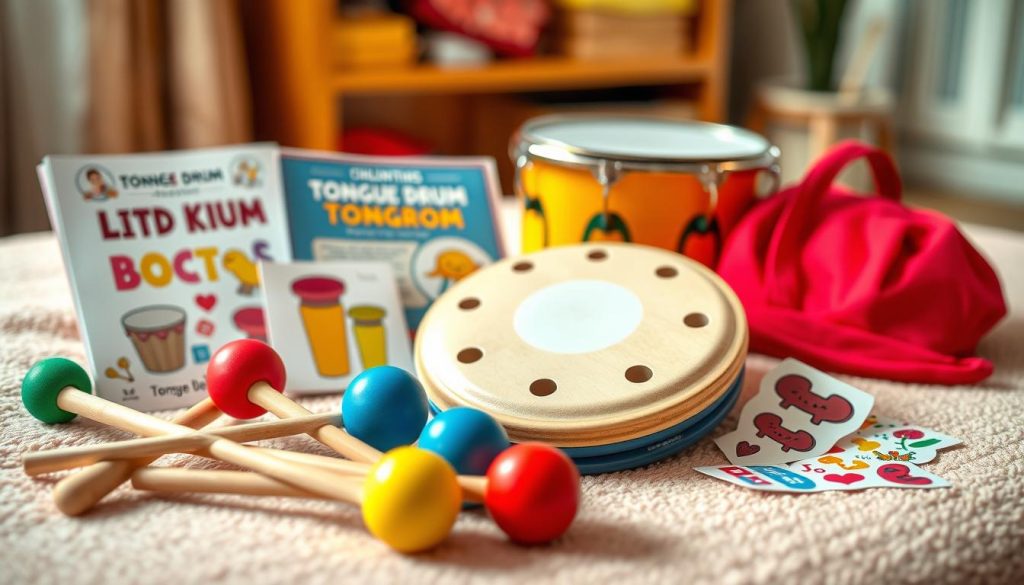
Mallets are the most useful accessory. They produce a fuller, softer sound than fingers, which is particularly suited to relaxation sessions. They also make playing easier for children who have not yet developed much finger strength.
Playing with the fingers, however, gives the player more sensitivity. It also allows damping: stopping a tongue’s vibration by resting a finger on it. Mallets usually produce a louder sound and are easier for very young children to use.
Finger protectors and other accessories
Finger protectors, or finger picks, fit over a child’s fingers. They make striking the tongues more comfortable and may suit children who prefer direct contact with the instrument.
Note stickers and an instruction booklet can also be valuable learning aids. They help children get started and play familiar melodies without needing to read music.
Cases and other transport aids
A carrying case is useful too. It protects the tongue drum from knocks, dust, and changes in temperature. Children can take their instrument to their grandparents’ home, on holiday, or to school.
Avoid basing your choice mainly on the included accessories. Replacement mallets, a case, and suitable sheet music can be bought separately. The quality of the instrument itself matters most.
Check whether the model includes at least mallets and a protective case so the child can start playing straight away. Some Fuzeau and Sonodrum tongue drums are sold with these accessories.
| Accessory | Description |
|---|---|
| Mallets | Produce a fuller, softer sound suited to relaxation sessions. |
| Finger protectors | Make playing more comfortable while preserving direct contact with the instrument. |
| Carrying case | Protects the instrument from knocks and makes it easier to carry. |
| Note stickers | Help identify notes and make learning easier. |
| Sheet music booklet | Helps children play melodies as they learn to read music. |
How much should you budget for a child’s tongue drum?
Set a suitable budget before buying. Tongue drum prices vary considerably with size and number of notes. Small models start at around €50. Larger models with more tongues can cost up to €200.
Prices for well-known brands can exceed €1,000, so consider value for money. An unbranded tongue drum may be an excellent first purchase, allowing a child to discover the instrument without a large expense.
Avoid buying an expensive model on impulse. Spending more than €200 on an instrument for a young beginner is usually unnecessary. The child may not benefit fully from a professional instrument’s finer qualities, and their interests may change or the instrument may be damaged.
For a sensible first purchase, consider an entry-level model such as the 18 cm, eight-tongue Fuzeau white tongue drum (reference 78461), which costs around €50 to €70. It offers a reasonable balance of sound quality and price.
Remember that a used tongue drum, even a branded one, may have a much lower resale value. You need not invest heavily in a child’s first instrument. The number of notes and the size directly affect the price: a 15-note tongue drum may cost roughly twice as much as an eight-note model.
Think of a tongue drum as an instrument your child can grow with. Start with an affordable model to spark their interest, then consider an upgrade if they continue to enjoy playing. For more information on choosing a model, see this article here.
Where can you buy a child’s tongue drum in France? Recommended brands and sellers
There are many places to buy a musical instrument suited to children. Choosing a reliable seller can make the buying experience much easier.
Well-known brands
Among established brands, Fuzeau offers a broad range designed with music education in mind, including models for different ages. Sonodrum also offers handmade instruments at competitive prices.
For more demanding musicians, brands such as Zenko and Rav Vast offer higher-end instruments. Although more expensive, they are known for their sound quality.
How to choose a trustworthy seller
When choosing a seller, look for responsive customer service and detailed customer reviews. A complete product description should specify the scale, tuning, material, and number of tongues.
A clear returns policy is another useful sign. It gives you options if the purchase does not meet your expectations.
Why accessories and a warranty matter
It is convenient to choose a tongue drum supplied with its essential accessories. Check whether mallets and a protective case are included so the instrument can be played as soon as it is unpacked.
Check the warranty as well: even a sturdy instrument can have manufacturing defects. A warranty of at least one year from a French seller may provide an exchange or refund if a problem arises.
Practical tips for using and learning to play the tongue drum
To get the most from this instrument, show young musicians playing techniques suited to their hands. Children can learn quickly while having fun and exploring its sounds.
Playing techniques for small hands
A natural technique is to strike the tongues with slightly curved fingertips. This lets them vibrate freely. Try striking a point about one-third of the tongue’s length from its free end.
Avoid striking with fingernails, which can produce a harsh metallic sound. Pressing the whole finger pad onto a tongue can also dampen its resonance. Let the finger bounce away after each strike, like a tennis ball, to allow the note to ring.
Children can play with the drum on a table or their lap, or hold it in their hands. Each position changes the acoustics and adds variety to the experience.
Encouraging creativity and intuitive playing
Encourage children to explore all the tongues freely without trying to play a particular tune. On a pentatonic instrument, many note combinations sound pleasant together. This nurtures creativity and enjoyment.
Color-coded scores, such as Fuzeau’s ColorZik system, can also be excellent teaching tools. They assign a color to each note so children can play familiar melodies without reading conventional notation.
Using the tongue drum in music and educational activities
In kindergarten, children can take turns playing in small group concerts. This supports group learning and helps them listen and respond to others. Accompanying familiar songs, such as “Happy Birthday,” makes practice fun.
Listening games in which children identify notes by ear can develop musical listening skills. They help children understand melodies and become more engaged with music.
To sustain children’s interest, vary their playing positions and show them inspiring performances by young musicians on platforms such as YouTube. Encouraging them to share their progress with family and friends can strengthen their motivation and confidence.
Conclusion: choose a tongue drum that suits your child and enjoy the music
The tongue drum is an accessible, versatile instrument for introducing young musicians to music. To make a good choice, consider an eight-tongue model measuring 18 to 20 cm that fits small hands. Choose a pentatonic scale for intuitive play, or a C major scale if playing familiar songs is the goal. Tuning to the 440 Hz reference helps the drum play with other instruments, while a budget of €40 to €80 can cover a suitable beginner model.
Choose an instrument that will support your child’s progress. A model with a little room to grow may remain useful after several months of practice. Beyond musical enjoyment, playing can develop emotional awareness, coordination, and creativity.
A tongue drum can bring years of musical enjoyment. Explore resources such as color-coded sheet music and online tutorials to enrich learning. Most of all, let children experiment: the instrument rewards exploration with beautiful sounds.